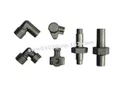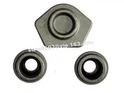

Can CNC machining parts be used in automotive manufacturing? You bet they can! As a supplier of CNC machining parts, I've seen firsthand how these parts have revolutionized the automotive industry. In this blog post, I'll dive into the details of why CNC machining parts are a perfect fit for automotive manufacturing, share some real - world examples, and give you a peek at the future of this technology in the automotive sector.
First off, let's talk about what CNC machining is. CNC stands for Computer Numerical Control. It's a manufacturing process where pre - programmed computer software dictates the movement of factory tools and machinery. This technology allows for highly precise and repeatable production of parts. When it comes to automotive manufacturing, precision is everything. Cars are complex machines with thousands of parts that need to fit together perfectly. A slight deviation in the size or shape of a part can lead to malfunctions, safety issues, and increased costs.


One of the biggest advantages of using CNC machining parts in automotive manufacturing is the high level of accuracy. CNC machines can produce parts with tolerances as tight as a few micrometers. This is crucial for components like engine pistons, valves, and transmission gears. For example, in an engine, the pistons need to fit precisely within the cylinders to ensure efficient combustion. A piston that's even a little too big or too small can cause reduced power, increased fuel consumption, and engine damage. With CNC machining, we can achieve the exact specifications required for these critical parts.
Another benefit is the ability to produce complex shapes. Modern cars are designed with aerodynamics, weight reduction, and performance in mind. This often results in parts with intricate geometries that are difficult or impossible to make using traditional manufacturing methods. CNC machining can handle these complex designs with ease. Whether it's a custom - shaped intake manifold or a lightweight suspension component, CNC machines can create parts that meet the most demanding design requirements.
Cost - effectiveness is also a major factor. While the initial investment in CNC machinery can be high, the long - term savings are significant. CNC machining is a highly automated process, which means less labor is required compared to manual machining. Additionally, the repeatability of CNC machining reduces waste and rework. Once a program is set up for a particular part, the machine can produce identical parts over and over again with minimal variation. This efficiency translates into lower production costs per part, making CNC machining parts an attractive option for automotive manufacturers.
Now, let's look at some specific examples of CNC machining parts used in automotive manufacturing. One common application is in the production of brake components. Brake calipers, rotors, and pads all require high precision and durability. CNC machining can produce brake calipers with smooth surfaces and accurate bore sizes, ensuring proper brake pad fit and optimal braking performance. The rotors can be machined to have the right thickness and surface finish to dissipate heat effectively and prevent warping.
Suspension systems are another area where CNC machining parts are widely used. Control arms, ball joints, and sway bars are all critical components that need to be strong, lightweight, and precisely engineered. CNC machining allows for the creation of suspension parts with the right combination of strength and weight. For instance, by using advanced materials and precision machining, we can make control arms that are both light enough to improve handling and strong enough to withstand the forces exerted during driving.
In the interior of the car, CNC machining parts are used for various components as well. Dashboard panels, steering wheel components, and gear shift knobs can all be produced using CNC machining. These parts need to have a high - quality finish and fit seamlessly into the overall design of the vehicle. CNC machining can achieve the smooth surfaces and precise dimensions required for a professional - looking interior.
As a CNC machining parts supplier, we offer a wide range of products for the automotive industry. For example, we have Stainless Steel 304 AIR HORNS that are not only durable but also have a high - quality finish. Our OEM Stainless Steel 303 CNC Lathe Services can be used to produce custom - made parts according to the specific requirements of automotive manufacturers. And if you're looking for cost - effective solutions, our China OEM Cheap Price CNC Parts Suppliers offer a great option.
Looking to the future, the use of CNC machining parts in automotive manufacturing is only going to increase. With the rise of electric vehicles (EVs), there will be a growing demand for new types of components. EVs require different battery enclosures, motor housings, and charging connectors, all of which can be efficiently produced using CNC machining. Additionally, as autonomous driving technology develops, there will be a need for more sensors and control systems, many of which will rely on precision - machined parts.
In conclusion, CNC machining parts are an essential part of modern automotive manufacturing. Their accuracy, ability to produce complex shapes, cost - effectiveness, and wide range of applications make them a top choice for automotive manufacturers. If you're in the automotive industry and looking for high - quality CNC machining parts, I encourage you to reach out to us. We're ready to work with you to meet your specific needs and help you take your automotive products to the next level. Let's start a conversation about how our CNC machining parts can fit into your manufacturing process.
References
- "Manufacturing Engineering Handbook" by Myer Kutz
- "Automotive Engineering Fundamentals" by Thomas D. Gillespie
- Industry reports on CNC machining in automotive manufacturing