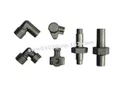

Forging parts play a crucial role in the chemical industry, where the demands for reliability, durability, and precision are extremely high. As a forging parts supplier, I understand the unique requirements that the chemical industry places on these components. In this blog post, I will delve into the key requirements for forging parts in the chemical industry and explain how our products meet these stringent standards.
Material Selection
One of the primary requirements for forging parts in the chemical industry is the selection of appropriate materials. Chemical processes often involve exposure to corrosive substances, high temperatures, and high pressures. Therefore, the materials used for forging parts must have excellent corrosion resistance, high strength, and good thermal stability.
Stainless steel is a popular choice for forging parts in the chemical industry due to its excellent corrosion resistance. Grades such as 304 and 316 stainless steel are commonly used, as they can withstand a wide range of corrosive chemicals. Additionally, alloy steels with specific alloying elements can be selected to enhance the material's resistance to corrosion and high temperatures. For example, steels containing chromium, nickel, and molybdenum offer improved corrosion resistance in harsh chemical environments.
In some cases, non - ferrous metals such as aluminum and titanium may also be used. Aluminum is lightweight and has good corrosion resistance, making it suitable for applications where weight reduction is a priority. Titanium, on the other hand, has excellent corrosion resistance and high strength - to - weight ratio, which is ideal for high - performance chemical processing equipment.
As a supplier, we offer a wide range of materials for forging parts. Our Custom 7year Experience Aluminum And Stainless Steel Forging Company has extensive experience in working with different metals, ensuring that we can provide the most suitable material for each specific chemical industry application.
Precision and Dimensional Accuracy
Precision is of utmost importance in the chemical industry. Forging parts must fit precisely into the equipment where they are used to ensure proper functioning and prevent leaks. Even a small deviation in dimensions can lead to significant problems, such as reduced efficiency, increased maintenance costs, and safety hazards.
We use advanced forging techniques and state - of - the - art machining equipment to achieve high precision and dimensional accuracy. Our manufacturing process includes strict quality control measures at every stage, from the initial forging to the final machining. We have a team of experienced engineers and technicians who use precision measuring instruments to verify the dimensions of each forging part, ensuring that they meet the exact specifications provided by our customers.
For example, in the production of valves and flanges, which are common forging parts in the chemical industry, we ensure that the bore diameter, flange thickness, and bolt hole spacing are all within the tight tolerance range. This high level of precision guarantees a perfect fit and reliable performance in chemical processing systems.


Mechanical Properties
Forging parts in the chemical industry need to have excellent mechanical properties to withstand the harsh operating conditions. They must have high strength to resist the high pressures and forces exerted during chemical processes. Additionally, good ductility is required to prevent brittle failure under stress.
Our forging process is designed to enhance the mechanical properties of the materials. Through proper heating, hammering, and shaping, we can refine the grain structure of the metal, which improves its strength and toughness. We also perform heat treatment processes such as annealing, quenching, and tempering to further optimize the mechanical properties of the forging parts.
For instance, in the production of pipes and fittings for chemical transportation, the forging parts need to have sufficient strength to withstand the internal pressure of the flowing chemicals. Our products are engineered to have the right balance of strength and ductility, ensuring long - term reliability in chemical industry applications.
Surface Finish
The surface finish of forging parts is another important requirement in the chemical industry. A smooth surface finish helps to prevent the accumulation of chemicals and contaminants, which can cause corrosion and fouling. It also reduces the risk of product contamination in the chemical processing.
We use various surface treatment methods to achieve a high - quality surface finish. These methods include grinding, polishing, and coating. Grinding and polishing can remove surface irregularities and create a smooth surface, while coatings can provide an additional layer of protection against corrosion.
For example, in the production of reaction vessels and storage tanks, a smooth surface finish is essential to prevent the adhesion of chemicals and ensure easy cleaning. Our forging parts are carefully treated to meet the strict surface finish requirements of the chemical industry.
Quantity and Cost - effectiveness
In the chemical industry, there is often a need for a large quantity of forging parts. As a supplier, we understand the importance of providing big - quantity orders at a low price. Our China Big Quantity With Low Price Cold Forging service is designed to meet the large - scale demand of the chemical industry.
We have a well - established production line and efficient manufacturing processes that allow us to produce forging parts in large quantities without sacrificing quality. By optimizing our production processes and sourcing raw materials at competitive prices, we can offer cost - effective solutions to our customers.
Quality Assurance and Certification
Quality assurance is a top priority in our business. We have a comprehensive quality management system in place to ensure that all our forging parts meet the highest quality standards. Our products are inspected and tested at multiple stages of the manufacturing process to ensure their compliance with relevant industry standards.
We also obtain various certifications to demonstrate the quality and reliability of our products. These certifications include ISO 9001 for quality management, as well as industry - specific certifications such as ASME for pressure - containing components.
Conclusion
In conclusion, the requirements for forging parts in the chemical industry are diverse and demanding. From material selection to precision, mechanical properties, surface finish, quantity, and cost - effectiveness, every aspect needs to be carefully considered. As a forging parts supplier, we are committed to meeting these requirements and providing high - quality products to the chemical industry.
If you are in the chemical industry and are looking for reliable forging parts, please feel free to contact us for procurement and negotiation. Our China Professional Forging Parts Manufacturers In Ningbo team is ready to provide you with customized solutions and excellent service.
References
- ASM Handbook Committee. (2008). ASM Handbook Volume 14A: Metalworking: Forging. ASM International.
- Schweitzer, P. A. (2005). Handbook of Valves. McGraw - Hill.
- Callister, W. D., & Rethwisch, D. G. (2011). Materials Science and Engineering: An Introduction. Wiley.