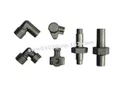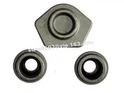

Forging is a manufacturing process that involves shaping metal using compressive forces. Dies play a crucial role in this process, acting as the molds that give forging parts their specific shapes and dimensions. As a forging parts supplier, I've witnessed firsthand the significance of dies in producing high - quality forging products. In this blog, I'll delve into the various roles of dies in forging parts.
1. Shaping the Forging Parts
The most fundamental role of dies in forging is to shape the metal into the desired form. Dies are precisely designed and machined to replicate the final shape of the forging part. When the heated metal blank is placed between the dies and pressure is applied, the metal flows into the cavities of the dies, taking on their shape.
For example, in the production of automotive crankshafts, the dies are engineered to create the complex curves and contours of the crankshaft. The upper and lower dies work in tandem to ensure that the metal is deformed accurately according to the design specifications. This shaping function is essential for meeting the strict dimensional requirements of different industries. Whether it's a simple bolt or a complex aerospace component, dies are the key to achieving the right shape.
Our company, with its Custom 7year Experience Aluminum And Stainless Steel Forging Company, has mastered the art of using dies to shape various metals. We can create custom - shaped forging parts for our clients, thanks to the precision of our die - making process.


2. Ensuring Dimensional Accuracy
Dimensional accuracy is a critical factor in forging parts. Dies are designed with extremely tight tolerances to ensure that the forged parts meet the required dimensions. During the forging process, the dies act as a guide, constraining the metal and preventing it from deforming beyond the specified limits.
The accuracy of the dies is maintained through advanced manufacturing techniques and quality control measures. For instance, Computer Numerical Control (CNC) machining is commonly used to produce dies with high precision. After the dies are manufactured, they are carefully inspected using coordinate measuring machines (CMMs) to verify their dimensions.
In the case of OEM 6061 - T6 Aluminium Forging With Heat Treatment, the dies are designed to produce parts with precise dimensions. This is crucial for applications where the parts need to fit together perfectly, such as in automotive engines or electronic devices. The dimensional accuracy provided by the dies ensures the functionality and reliability of the forging parts.
3. Improving Mechanical Properties
Dies also play a role in improving the mechanical properties of forging parts. When the metal is forged between the dies, it undergoes plastic deformation, which aligns the grain structure of the metal. This alignment of the grain structure enhances the strength, toughness, and fatigue resistance of the forging parts.
For example, in the Aluminum Forging Process With Heat Treatment, the dies help in controlling the deformation process. The heat treatment applied after forging further enhances the mechanical properties. The combination of proper die design and heat treatment can result in aluminum forging parts with excellent strength - to - weight ratios, making them suitable for aerospace and automotive applications.
The dies can also be designed to introduce specific features that improve the mechanical performance of the parts. For instance, ribs or bosses can be incorporated into the die design to increase the stiffness of the forging part.
4. Increasing Production Efficiency
In a forging production line, dies contribute significantly to increasing production efficiency. Once the dies are properly set up, they can be used repeatedly to produce a large number of identical forging parts. This reduces the time and cost associated with producing each part individually.
The design of the dies also affects the forging cycle time. Well - designed dies allow for faster metal flow and shorter forging strokes, which in turn reduces the overall production time. Additionally, dies can be designed for multi - cavity forging, where multiple parts are forged simultaneously in a single stroke.
Our forging parts supplier company has optimized our die designs to maximize production efficiency. We can produce a large volume of high - quality forging parts in a relatively short time, meeting the demands of our clients in a timely manner.
5. Enhancing Surface Finish
The surface finish of forging parts is another important aspect, especially for parts that are visible or require a smooth surface for proper functioning. Dies can be polished and treated to improve the surface finish of the forged parts.
During the forging process, the surface of the dies transfers its texture to the metal. By ensuring a smooth and defect - free die surface, we can achieve a better surface finish on the forged parts. This is particularly important for parts that are used in applications where aesthetics or low friction are required, such as in consumer products or medical devices.
We pay great attention to the surface treatment of our dies. Through processes like electro - polishing and nitriding, we can improve the surface hardness and smoothness of the dies, resulting in forging parts with an excellent surface finish.
6. Cost - Effectiveness
Although the initial cost of die - making can be relatively high, in the long run, dies offer cost - effectiveness in forging production. Once the dies are produced, they can be used for a large number of forging operations. The cost per part decreases as the production volume increases.
Moreover, the use of dies reduces the amount of scrap material generated during the forging process. Since the dies control the shape and dimensions of the parts, there is less material waste compared to other manufacturing processes. This not only saves on material costs but also has environmental benefits.
As a forging parts supplier, we understand the importance of cost - effectiveness for our clients. We work closely with them to optimize the die - design and forging process to minimize costs while maintaining high quality.
Contact Us for Your Forging Needs
If you are in need of high - quality forging parts, we are here to help. Our experience in using dies to produce forging parts with excellent shape, dimensional accuracy, and mechanical properties makes us a reliable partner. Whether you need a small batch of custom - designed parts or a large - scale production run, we have the capabilities to meet your requirements.
Contact us today to discuss your forging needs and start a procurement negotiation. We look forward to working with you to provide the best forging solutions.
References
- Dieter, G. E. (1988). Mechanical Metallurgy. McGraw - Hill.
- Kalpakjian, S., & Schmid, S. R. (2008). Manufacturing Engineering and Technology. Pearson Prentice Hall.
- Totten, G. E., & MacKenzie, D. E. (2003). Handbook of Aluminum. CRC Press.