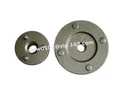

Hey there! I'm a supplier of forging parts, and today I wanna chat about whether forging parts can be heat-treated further. It's a question I get a lot from my customers, so I thought I'd dive deep into it.
First off, let's talk about what forging is. Forging is a manufacturing process where metal is shaped by applying compressive forces. This can be done using hammers, presses, or other tools. The result is a part that has a better grain structure and mechanical properties compared to parts made by other methods like casting.
Now, heat treatment is a process used to alter the physical and sometimes chemical properties of a material. It involves heating the material to a specific temperature, holding it at that temperature for a certain period, and then cooling it at a controlled rate. Heat treatment can improve hardness, strength, toughness, and other properties of the metal.
So, can forging parts be heat-treated further? The short answer is yes, in most cases. But there are a few things to consider.
Why Heat-Treat Forged Parts?
There are several reasons why you might want to heat-treat a forged part. One of the main reasons is to improve its mechanical properties. For example, if you need a part to be harder and more wear-resistant, you can use a heat treatment process like quenching and tempering. Quenching involves heating the part to a high temperature and then rapidly cooling it in a liquid, like oil or water. This creates a very hard but brittle structure. Tempering is then done to reduce the brittleness and improve the toughness of the part.
Another reason to heat-treat forged parts is to relieve internal stresses. During the forging process, stresses can build up in the metal. These stresses can cause the part to deform or crack over time. Heat treatment can help to relieve these stresses and make the part more stable.
Types of Heat Treatment for Forged Parts
There are several types of heat treatment that can be applied to forged parts. Here are some of the most common ones:
Annealing
Annealing is a heat treatment process that involves heating the part to a specific temperature, holding it there for a period of time, and then slowly cooling it. This process softens the metal, reduces internal stresses, and improves its machinability. There are different types of annealing, such as full annealing, process annealing, and stress relief annealing.
Normalizing
Normalizing is similar to annealing, but the cooling rate is faster. This results in a finer grain structure and improved mechanical properties. Normalizing is often used to prepare the part for further heat treatment or machining.
Quenching and Tempering
As mentioned earlier, quenching and tempering is a two-step process used to improve the hardness and toughness of the metal. Quenching creates a hard but brittle structure, and tempering reduces the brittleness and improves the toughness.
Case Hardening
Case hardening is a process where the surface of the part is hardened while the core remains relatively soft. This is useful for parts that need to be wear-resistant on the surface but still have good toughness in the core. There are different methods of case hardening, such as carburizing, nitriding, and carbonitriding.
Factors to Consider
When deciding whether to heat-treat a forged part, there are several factors to consider.

Material
The type of material used in the forging plays a big role in determining whether it can be heat-treated and what type of heat treatment is appropriate. For example, some steels are more easily heat-treated than others. Stainless steels, for instance, have different heat treatment requirements compared to carbon steels. If you're interested in OEM Stainless Steel 304 Precise Custom Forgings, you'll need to understand the specific heat treatment processes that work best for this material.
Forging Process
The way the part is forged can also affect its heat treatment. For example, if the part has a complex shape or a large cross-section, it may be more difficult to heat-treat evenly. This can lead to uneven hardness and other issues.
Application
The intended application of the part is another important factor. If the part will be used in a high-stress environment, it may require a more rigorous heat treatment to ensure it can withstand the loads. On the other hand, if the part is used in a less demanding application, a simpler heat treatment may be sufficient.
Our Offerings
As a forging parts supplier, I offer a wide range of High Quality Forging Stainless Steel products. We also provide custom forging services, including OEM 6061-T6 Forged Aluminum With CNC Machining. Our team of experts can help you determine the best heat treatment process for your specific needs.
If you're in the market for forging parts and have questions about heat treatment or any other aspect of our products, don't hesitate to reach out. We're here to help you get the best parts for your application. Whether you need a small batch of custom parts or a large production run, we've got you covered.
Conclusion
In conclusion, forging parts can usually be heat-treated further to improve their mechanical properties and relieve internal stresses. However, it's important to consider factors like the material, forging process, and application when deciding on the appropriate heat treatment. As a forging parts supplier, I'm committed to providing high-quality products and helping my customers find the best solutions for their needs. If you're interested in learning more or have a project in mind, feel free to contact me for a consultation.
References
- ASM Handbook, Volume 4: Heat Treating. ASM International.
- Metals Handbook Desk Edition, Third Edition. ASM International.
So, if you're looking for top-notch forging parts and need advice on heat treatment or other related topics, drop me a line. Let's start a conversation and see how we can work together to meet your requirements.