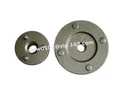

In the world of manufacturing, forging parts play a crucial role across various industries, from automotive to aerospace and construction. As a forging parts supplier, ensuring the quality of our products is not just a goal; it's an unwavering commitment. This blog delves into the essential quality standards that govern forging parts and how we adhere to them to deliver top - notch products.
Material Selection and Quality
The foundation of a high - quality forging part lies in the selection of the right material. Different applications demand different material properties, such as strength, hardness, ductility, and corrosion resistance. For example, in the automotive industry, where parts need to withstand high stress and fatigue, we often use carbon steel due to its excellent strength - to - weight ratio.
When it comes to material sourcing, we follow strict guidelines. We only partner with trusted suppliers who can provide material certificates. These certificates verify the chemical composition and mechanical properties of the raw materials. For instance, for a carbon steel forging, the certificate will specify the percentage of carbon, manganese, sulfur, and other elements, ensuring that it meets the required standards.
We also conduct in - house material testing on a regular basis. Using advanced testing equipment like spectrometers, we can analyze the chemical composition of the incoming materials. Tensile testing machines are used to determine the strength and ductility of the materials, ensuring that they can withstand the forging process and subsequent use in the end - product.
Dimensional Accuracy
Dimensional accuracy is another critical quality standard for forging parts. Even a small deviation from the specified dimensions can lead to problems in the assembly process or affect the performance of the final product.
We utilize state - of - the - art machining and inspection equipment to ensure dimensional accuracy. Computer - Numerical - Control (CNC) machines are commonly used in our manufacturing process. These machines are programmed to cut and shape the forging parts with high precision, reducing the margin of error.
In addition to CNC machining, we employ advanced inspection techniques. Coordinate Measuring Machines (CMMs) are used to measure the dimensions of the forging parts. CMMs can accurately measure complex geometries and provide detailed reports on the dimensional accuracy of each part. By comparing the measured values with the design specifications, we can quickly identify any deviations and take corrective actions.
For custom - fabricated parts, such as Custom Fabrication Carbon Steel Hot Forging Parts, we work closely with our customers to understand their exact requirements. Through detailed communication and sharing of design drawings, we can ensure that the final product meets or exceeds their expectations in terms of dimensional accuracy.
Surface Finish
The surface finish of forging parts is not only important for aesthetic reasons but also for functional performance. A smooth surface finish can reduce friction, prevent corrosion, and improve the overall durability of the part.
We use various surface treatment methods to achieve the desired surface finish. For example, shot blasting is a common technique used to clean the surface of the forging parts and enhance their surface roughness. This process involves propelling small metal shots at high speed onto the surface of the part, removing any scale, rust, or impurities.
Another popular surface treatment method is heat treatment, which can also affect the surface finish and properties of the forging parts. As described in Aluminum Forging Process With Heat Treatment, heat treatment can improve the hardness, strength, and ductility of the aluminum forging parts while also ensuring a uniform surface finish.
We also conduct visual inspections to check the surface quality of the forging parts. Any surface defects, such as cracks, pits, or scratches, are identified and either repaired or the parts are rejected. This ensures that only parts with a high - quality surface finish are delivered to our customers.
Mechanical Properties
The mechanical properties of forging parts, such as strength, hardness, toughness, and fatigue resistance, are crucial for their performance in different applications. These properties are determined by factors such as the material selection, forging process, and heat treatment.
During the forging process, we carefully control the temperature, pressure, and deformation rate to ensure that the desired mechanical properties are achieved. For example, in hot forging, the material is heated to a high temperature to make it more malleable, and then it is subjected to high - pressure deformation to shape the part. The right combination of temperature and pressure can refine the grain structure of the material, resulting in improved strength and toughness.
Heat treatment is another important step in enhancing the mechanical properties of forging parts. Through processes like annealing, quenching, and tempering, we can change the microstructure of the material and achieve the desired hardness and toughness. For instance, quenching a steel forging can increase its hardness, while tempering can relieve the internal stresses and improve its toughness.
We regularly conduct mechanical property testing on our forging parts. This includes hardness testing using hardness testers and impact testing using Charpy or Izod impact testing machines. By ensuring that the mechanical properties of our parts meet the relevant standards, we can provide reliable products to our customers.


Non - Destructive Testing (NDT)
Non - destructive testing is an essential quality control measure for forging parts. It allows us to detect internal and surface defects without damaging the part, ensuring the integrity and reliability of the product.
We use several NDT methods, such as ultrasonic testing (UT), magnetic particle testing (MT), and liquid penetrant testing (PT). Ultrasonic testing is used to detect internal defects, such as cracks, flaws, or inclusions, inside the forging parts. A high - frequency ultrasonic wave is sent into the part, and any reflections from defects are detected and analyzed.
Magnetic particle testing is suitable for detecting surface and near - surface defects in ferromagnetic materials. A magnetic field is applied to the part, and iron powder is sprinkled on the surface. If there are any defects, the magnetic field will be disrupted, and the iron powder will accumulate at the defect site, making it visible.
Liquid penetrant testing is used to detect surface - opening defects. A penetrant liquid is applied to the surface of the part, and after a certain period, the excess liquid is removed. A developer is then applied, which draws out the penetrant from the defects and makes them visible.
By using these NDT methods, we can ensure that our forging parts are free from critical defects and meet the required quality standards.
Quality Management System
To ensure consistent quality across all our products, we have implemented a comprehensive quality management system. This system encompasses all aspects of our manufacturing process, from material sourcing to product delivery.
We follow international standards such as ISO 9001, which provides a framework for quality management. Our quality management system includes procedures for quality planning, quality control, and quality improvement. Regular internal audits are conducted to assess the effectiveness of the system and identify areas for improvement.
Employee training is also an important part of our quality management system. All our employees are trained on quality control procedures and standards, ensuring that they understand their role in delivering high - quality products.
Our Experience and Expertise
With Custom 7year Experience Aluminum And Stainless Steel Forging Company, we have accumulated extensive experience in the forging industry. Our team of engineers and technicians has in - depth knowledge of the forging process and quality control techniques.
We have a proven track record of providing high - quality forging parts to customers in various industries. Our commitment to quality has earned us a reputation as a reliable forging parts supplier. We continuously invest in research and development to improve our manufacturing processes and product quality.
Contact for Purchase and Negotiation
We understand that each customer has unique requirements, and we are dedicated to providing customized solutions. Whether you need high - precision carbon steel forging parts or aluminum forging parts with specific heat treatment, we can meet your needs.
If you are interested in our forging parts and would like to discuss your requirements, please feel free to contact us. We are eager to engage in purchase negotiations and provide you with the best - quality products at competitive prices.
References
- ASME Boiler and Pressure Vessel Code.
- ASTM International Standards for Forging.
- ISO 9001:2015 Quality Management Systems Requirements.