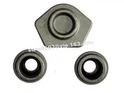

Hey there! I'm a supplier of forging parts, and today I want to dig into the question: Can forging parts be surface - hardened? It's a topic that often comes up in the industry, and I'm here to share some insights based on my experience.
First off, let's understand what surface hardening is. Surface hardening is a heat treatment process that increases the hardness of the outer layer of a metal part while keeping the core relatively soft and tough. This can enhance the wear resistance, fatigue strength, and corrosion resistance of the part. And the answer to whether forging parts can be surface - hardened is a big yes!
Forging is a manufacturing process where metal is shaped by applying compressive forces. The process can improve the grain structure of the metal, making it stronger and more durable. And this very structure can also benefit from surface hardening.
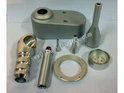
There are several methods of surface hardening that can be applied to forging parts. One common method is carburizing. In carburizing, the forging part is heated in a carbon - rich environment. The carbon diffuses into the surface layer of the metal, increasing its carbon content. When the part is quenched, the high - carbon surface layer forms a hard martensite structure. This is great for parts that need high wear resistance, like gears and shafts. For example, our OEM A105 Aisi1045 Small Steel Metal Forge can be effectively carburized to enhance its surface properties.
Another method is nitriding. Nitriding involves heating the forging part in a nitrogen - rich atmosphere. Nitrogen atoms diffuse into the surface of the metal, forming hard nitrides. This process can be done at lower temperatures compared to carburizing, which means less distortion of the part. It's ideal for parts that require good fatigue resistance and a hard, wear - resistant surface. Our forging parts made from certain steels can benefit greatly from nitriding.
Induction hardening is also a popular choice. In induction hardening, an alternating current is passed through a coil, creating a magnetic field. When the forging part is placed in this magnetic field, eddy currents are induced in the surface layer of the part, heating it rapidly. The part is then quenched to harden the surface. This method is very precise and can be used to harden specific areas of the forging part. It's often used for parts like crankshafts and camshafts.
Now, let's talk about the materials. Different materials respond differently to surface hardening. Steel forging parts are the most common candidates for surface hardening. Steels with different carbon contents and alloying elements can be treated to achieve the desired surface hardness. For example, low - carbon steels are often carburized to increase the carbon content in the surface layer, while medium - and high - carbon steels can be directly quenched and tempered to harden the surface.
Aluminum forging parts can also be surface - hardened, although the process is a bit different. For our OEM 6061 - T6 Aluminium Forging With Heat Treatment, heat treatment is an important step. Aluminum alloys can be age - hardened, which involves heating the part to a specific temperature and then holding it there for a certain period of time to allow precipitation of hardening phases. This can improve the strength and hardness of the aluminum forging part.
One of the advantages of surface - hardening forging parts is cost - effectiveness. Instead of using a more expensive high - alloy steel throughout the entire part, you can use a lower - cost base material and then surface - harden it. This way, you get the benefits of a hard surface and a tough core at a lower cost.
Another advantage is performance improvement. A surface - hardened forging part can have better wear resistance, which means it will last longer in service. This is especially important for parts that are subjected to high - stress and high - wear conditions, like automotive components and industrial machinery parts.


However, there are also some challenges in surface - hardening forging parts. One of the main challenges is distortion. During the heat treatment process, the part can warp or change shape due to the thermal stresses. This requires careful control of the process parameters, such as heating rate, quenching rate, and holding time. Another challenge is the quality control of the surface - hardened layer. The hardness, depth, and uniformity of the surface - hardened layer need to be carefully monitored to ensure the part meets the required specifications.
As a forging parts supplier, we have the expertise and equipment to perform surface hardening on our products. We work closely with our customers to understand their specific requirements and choose the most suitable surface - hardening method. Whether you need a small batch of custom - made forging parts or a large - scale production, we can provide high - quality surface - hardened forging parts.
If you're in the market for forging parts and are interested in surface - hardening options, we're here to help. Our High Quality Aluminum Forging Manufacturers team is dedicated to delivering top - notch products. Just reach out to us, and we can start discussing your project. We can provide samples, technical support, and competitive pricing. Let's work together to find the best solution for your forging part needs.
In conclusion, forging parts can definitely be surface - hardened, and it offers many benefits in terms of performance and cost. With the right materials, processes, and quality control, we can produce surface - hardened forging parts that meet the highest standards. So, if you have any questions or are looking to source forging parts, don't hesitate to get in touch. We're eager to assist you in your procurement process.
References
ASM Handbook Volume 4: Heat Treating. ASM International.
Davis, J.R. (Ed.). (2001). Aluminum and Aluminum Alloys. ASM International.