
Hey there! As a supplier of 2.4851, I often get asked about how this specific number relates to the standard deviation in a normal distribution. Well, let's dive right into it and break down this somewhat complex topic in a way that's easy to understand.
First off, a normal distribution, also known as a Gaussian distribution, is a super important concept in statistics. It's that bell - shaped curve you've probably seen at some point. The curve is symmetric around the mean, and the standard deviation is a measure of how spread out the data is from the mean.
So, where does 2.4851 fit into all this? In a normal distribution, we use the standard deviation to figure out how likely it is to find a particular value within a certain range. For example, about 68% of the data falls within one standard deviation of the mean, 95% falls within two standard deviations, and around 99.7% falls within three standard deviations.
But 2.4851 isn't a typical number associated with these well - known percentages. However, it could represent a specific z - score. A z - score tells you how many standard deviations an element is from the mean. If we have a z - score of 2.4851, it means that the value we're looking at is 2.4851 standard deviations away from the mean.
Let's say we're dealing with a set of data that follows a normal distribution, like the weights of a certain type of product we manufacture. If the mean weight is 50 grams and the standard deviation is 5 grams, and we have a z - score of 2.4851, we can calculate the actual weight of the product. We use the formula (x=\mu + z\sigma), where (\mu) is the mean, (z) is the z - score, and (\sigma) is the standard deviation. So, (x = 50+2.4851\times5=50 + 12.4255 = 62.4255) grams.
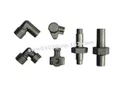
Now, from a supplier's perspective, understanding this relationship between 2.4851 and the standard deviation can be really useful. For instance, when we're producing parts with specific specifications. Let's say we're making fasteners, like the Din 933 Din912 Din934 904L Fasteners. We need to ensure that the dimensions of these fasteners are within a certain tolerance range. By using the concept of standard deviation and z - scores, we can predict how many fasteners might fall outside of the acceptable range.
If we set the mean diameter of the fasteners to be 10 mm and the standard deviation to be 0.1 mm, and we know that a z - score of 2.4851 represents the upper limit of our tolerance, we can calculate the maximum acceptable diameter. Using the formula (x=\mu + z\sigma), we get (x = 10+2.4851\times0.1=10.24851) mm. This helps us in quality control and ensuring that our products meet the required standards.
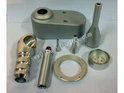
Another area where this knowledge comes in handy is in custom machining services. We offer OEM 316L Machining Services as drawing. When machining parts according to specific blueprints, there are always some variations in the final products due to factors like machine precision and material properties. By understanding the relationship between values like 2.4851 and the standard deviation, we can better manage these variations.
We can also use this concept when dealing with materials like 2.4602, Alloy 22, UNS N06022 Stainless Steel Bolt Hollow Acme Threaded Rods. The properties of these materials, such as their strength and corrosion resistance, can vary. By analyzing the data on these properties using normal distribution and z - scores, we can determine the likelihood of getting a product with a certain level of quality.


In the real world, things aren't always perfect. There are always going to be some outliers in the data. But by having a good understanding of how 2.4851 (or any other z - score) relates to the standard deviation, we can make more informed decisions. For example, if we notice that a large number of products are falling beyond a z - score of 2.4851, it might be a sign that there's something wrong with our manufacturing process. Maybe the machines need to be calibrated, or the raw materials aren't up to par.
So, as a supplier, this knowledge helps us in multiple ways. It allows us to manage quality, optimize our production processes, and ultimately provide better products to our customers. Whether it's fasteners, machined parts, or specialty materials, the relationship between 2.4851 and the standard deviation in a normal distribution is a powerful tool in our toolkit.
If you're in the market for high - quality products like the ones I've mentioned above, or if you have any questions about how we use these statistical concepts to ensure product quality, I'd love to have a chat. Feel free to reach out and let's start a conversation about your specific needs. We're always here to provide the best solutions for your business.
References
- "Statistics for Dummies" by Deborah Rumsey
- "Probability and Statistics" course materials from various universities