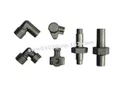

Hey there! I'm a supplier of forging parts, and I've been in this industry for quite some time. Over the years, I've seen a lot of debates about whether forging parts are better than cast parts. Well, let me tell you, in my experience, forging parts have some serious advantages over cast parts. So, let's dive right in and explore what makes forging parts stand out.
1. Superior Strength and Durability
One of the biggest advantages of forging parts is their superior strength. When we forge a part, we're basically shaping metal under high pressure. This process aligns the grain structure of the metal in a way that follows the shape of the part. As a result, the forging part has a more consistent and directional grain flow, which gives it better mechanical properties.
For example, in applications where parts are subjected to high stress, like in automotive engines or aerospace components, forging parts can handle the load much better than cast parts. Cast parts, on the other hand, have a more random grain structure, which can lead to weak points and potential failure under stress.
Let's say you're building a high - performance engine. The connecting rods, which are crucial for transferring power from the pistons to the crankshaft, need to be extremely strong. A forged connecting rod will be able to withstand the high forces and vibrations generated by the engine without deforming or breaking. In contrast, a cast connecting rod might crack or fail over time, leading to costly repairs or even engine failure.
2. Improved Fatigue Resistance
Forging parts also have better fatigue resistance compared to cast parts. Fatigue is the weakening of a material caused by repeated loading and unloading. In many industrial applications, parts are constantly subjected to cyclic stresses, such as in machinery that operates continuously.
The directional grain flow in forging parts helps to resist the initiation and propagation of cracks. When a crack starts to form in a forging part, the aligned grains can act as a barrier, preventing the crack from spreading quickly. Cast parts, with their random grain structure, are more prone to crack growth under cyclic loading.
Take the example of a suspension component in a vehicle. This part is constantly being jolted and stressed as the vehicle moves over uneven surfaces. A forged suspension part will be able to endure thousands of cycles of stress without showing significant signs of fatigue. A cast suspension part, however, may develop cracks over time, compromising the safety and performance of the vehicle.
3. Precision and Dimensional Accuracy
Forging allows for a high degree of precision and dimensional accuracy. Modern forging techniques, such as closed - die forging, can produce parts with tight tolerances. This means that the forging parts will fit exactly as intended in the final assembly, reducing the need for additional machining or fitting.
In industries where precision is critical, like the medical or electronics industries, forging parts are often the preferred choice. For instance, in the production of surgical instruments, the parts need to be made with extreme accuracy to ensure proper functionality. A forged surgical instrument can be produced to the exact specifications required, ensuring a perfect fit and reliable performance.
In comparison, cast parts may require more extensive machining to achieve the same level of precision. Casting processes can introduce variations in the dimensions of the part due to factors like shrinkage during cooling. This can lead to additional costs and longer production times.
4. Material Utilization
Forging is a more efficient process in terms of material utilization. When we forge a part, we start with a billet or a pre - formed piece of metal and shape it into the desired form. There is relatively little waste material generated during the forging process.
On the other hand, casting often involves pouring molten metal into a mold. There can be significant amounts of excess metal that need to be removed after casting, either through machining or other finishing processes. This excess material not only adds to the cost but also has an environmental impact.
For example, if we're making a large - scale industrial component, using a forging process can save a substantial amount of raw material. This not only reduces the cost of production but also makes the manufacturing process more sustainable.


5. Better Surface Finish
Forging parts generally have a better surface finish compared to cast parts. The high - pressure forging process compresses the metal, resulting in a smoother and more uniform surface. This can be beneficial in many applications, as a good surface finish can reduce friction, improve wear resistance, and enhance the aesthetic appeal of the part.
In industries where appearance matters, such as in consumer products or architectural applications, forging parts can provide a more polished look. For example, in the production of high - end furniture hardware or decorative metal components, a forged part with a smooth surface finish will look more attractive and professional.
Cast parts may have a rougher surface due to the nature of the casting process. They often require additional surface finishing operations, such as grinding or polishing, to achieve a comparable surface quality.
6. Availability of a Wide Range of Materials
We can forge a wide variety of materials, including aluminum, steel, titanium, and more. This gives us the flexibility to choose the most suitable material for a specific application. For example, Aluminum Forging Process With Heat Treatment is a popular option for applications where lightweight and corrosion - resistant parts are needed, such as in the aerospace and automotive industries.
When it comes to cast parts, the choice of materials may be more limited. Some materials may be difficult to cast due to their high melting points or other properties. Forging, on the other hand, can handle a broader range of materials, allowing us to meet the diverse needs of our customers.
7. Customization and Flexibility
As a forging parts supplier, I can offer a high level of customization. We can design and produce forging parts in various shapes and sizes to meet the specific requirements of our customers. Whether it's a simple, standard part or a complex, one - of - a - kind component, forging technology allows us to create it with precision.
In contrast, casting may have some limitations when it comes to complex shapes. Some intricate designs may be difficult to achieve through casting due to issues like mold filling and solidification. Forging, with its ability to shape metal under high pressure, gives us more flexibility in creating complex geometries.
If you're looking for High Quality Aluminum Forging Manufacturers or China Professional Forging Parts Manufacturers In Ningbo, we've got you covered. We have the expertise and experience to produce high - quality forging parts that meet your exact specifications.
Conclusion
In conclusion, forging parts offer numerous advantages over cast parts, including superior strength, better fatigue resistance, precision, efficient material utilization, better surface finish, a wide range of material options, and high customization. If you're in the market for high - quality, reliable parts for your industrial, automotive, aerospace, or other applications, forging parts are definitely the way to go.
If you're interested in learning more about our forging parts or would like to discuss a potential project, don't hesitate to reach out. We're always happy to have a chat and see how we can help you with your forging needs. Let's work together to create the perfect parts for your applications!
References
- "Metal Forming: Processes and Applications" by George E. Dieter
- "Manufacturing Engineering and Technology" by S. Kalpakjian and S. R. Schmid