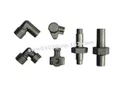

Forging parts play a crucial role in various industries, and the sealant industry is no exception. As a forging parts supplier, I have witnessed firsthand how these components contribute to the efficiency and reliability of sealant production and application processes. In this blog, I will explore the different types of forging parts used in the sealant industry and their significance.
The Role of Forging Parts in the Sealant Industry
The sealant industry encompasses a wide range of products, including adhesives, caulks, and sealants used in construction, automotive, aerospace, and other sectors. Forging parts are essential in the manufacturing, packaging, and application of these products. They provide the strength, durability, and precision required to handle the high pressures, temperatures, and chemical environments associated with sealant production and use.


Types of Forging Parts Used in the Sealant Industry
1. Pump Components
Pumps are used to transfer sealant materials from storage containers to application equipment. Forged pump components, such as pistons, cylinders, and valves, are designed to withstand the high pressures and abrasive nature of sealant materials. These parts are typically made from high-strength metals, such as carbon steel, stainless steel, or brass, to ensure long-lasting performance.
- OEM Carbon Steel Stainless Steel Hot Forging: Our OEM Carbon Steel Stainless Steel Hot Forging products are precision-engineered to meet the exact specifications of pump manufacturers. These forgings offer excellent strength, corrosion resistance, and dimensional accuracy, making them ideal for pump components in the sealant industry.
2. Mixing and Dispensing Equipment
Mixing and dispensing equipment is used to blend sealant components and apply them to the desired surfaces. Forged parts, such as mixing chambers, nozzles, and dispensers, are critical for ensuring accurate and consistent mixing and application of sealants. These parts are often made from materials that are resistant to chemical corrosion and wear, such as aluminum or brass.
- Customize China CuZn39Pb3 Brass Forging: Our Customize China CuZn39Pb3 Brass Forging services allow us to create custom mixing and dispensing components tailored to the specific needs of our customers. Brass forgings offer excellent machinability, corrosion resistance, and thermal conductivity, making them suitable for a variety of sealant applications.
3. Packaging Equipment
Packaging equipment is used to fill sealant products into containers, such as tubes, cartridges, or drums. Forged parts, such as filling nozzles, pistons, and closures, are essential for ensuring efficient and accurate packaging of sealants. These parts are designed to prevent leakage and contamination of the sealant products during the packaging process.
- High Quality Aluminum Forging Manufacturers: As one of the High Quality Aluminum Forging Manufacturers, we produce high-quality aluminum forgings for packaging equipment in the sealant industry. Aluminum forgings offer a combination of lightweight, strength, and corrosion resistance, making them ideal for packaging applications.
4. Molds and Dies
Molds and dies are used to shape and form sealant products during the manufacturing process. Forged molds and dies are essential for producing high-quality sealant products with consistent dimensions and surface finishes. These parts are typically made from tool steels, which offer high hardness, wear resistance, and thermal stability.
Benefits of Using Forging Parts in the Sealant Industry
1. Strength and Durability
Forging parts are known for their superior strength and durability compared to other manufacturing processes, such as casting or machining. The forging process aligns the grain structure of the metal, resulting in parts that are more resistant to fatigue, impact, and wear. This makes forging parts ideal for use in the harsh environments of the sealant industry.
2. Precision and Dimensional Accuracy
Forging allows for the production of parts with high precision and dimensional accuracy. This is crucial in the sealant industry, where tight tolerances are required to ensure proper fit and function of components. Forged parts can be manufactured to meet the exact specifications of our customers, reducing the need for additional machining or finishing operations.
3. Cost-Effectiveness
While the initial cost of forging parts may be higher than other manufacturing processes, the long-term cost savings can be significant. Forging parts have a longer service life, reducing the need for frequent replacements. Additionally, the high precision and dimensional accuracy of forging parts can reduce scrap rates and improve overall production efficiency.
4. Customization
Forging offers a high degree of customization, allowing us to create parts that are tailored to the specific needs of our customers. We can work with our customers to develop custom designs, materials, and finishes to meet their unique requirements. This flexibility makes forging parts an ideal choice for the sealant industry, where a wide range of products and applications exist.
Conclusion
Forging parts play a vital role in the sealant industry, providing the strength, durability, precision, and customization required for efficient and reliable sealant production and application. As a forging parts supplier, we are committed to providing our customers with high-quality products and exceptional service. Whether you need pump components, mixing and dispensing equipment, packaging equipment, or molds and dies, we have the expertise and capabilities to meet your needs.
If you are interested in learning more about our forging parts for the sealant industry or would like to discuss your specific requirements, please contact us. We look forward to working with you to find the best solutions for your business.
References
- ASM Handbook, Volume 14A: Metalworking: Forging, ASM International
- Forging Industry Association (FIA) Technical Papers
- Manufacturing Engineering and Technology, by Serope Kalpakjian and Steven Schmid