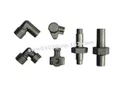

As a forging parts supplier, I've had the privilege of working with a wide range of die materials to create high - quality forging products. The choice of die material is crucial as it directly impacts the quality, cost, and efficiency of the forging process. In this blog, I'll explore the various die materials used for forging parts and their characteristics.
1. Tool Steels
Tool steels are the most commonly used die materials in forging due to their excellent combination of hardness, toughness, and wear resistance. They can be further classified into several types based on their chemical composition and heat - treatment properties.
Hot - Work Tool Steels
Hot - work tool steels are designed to withstand high temperatures and mechanical stresses during hot forging processes. One of the most popular hot - work tool steels is H13. H13 has good hardenability, high thermal fatigue resistance, and excellent toughness. It can maintain its hardness and strength at elevated temperatures, making it suitable for dies used in hot forging of aluminum, steel, and other metals. For example, when forging large aluminum parts, H13 dies can endure the repeated thermal cycling and mechanical impacts, ensuring a long service life and high - quality forgings.
The heat - treatment process of H13 involves quenching and tempering. Quenching helps to achieve the desired hardness, while tempering relieves internal stresses and improves toughness. By carefully controlling the heat - treatment parameters, we can optimize the performance of H13 dies for specific forging applications.
Cold - Work Tool Steels
Cold - work tool steels are used for cold forging operations where the forging is done at or near room temperature. D2 is a well - known cold - work tool steel. It has high carbon and chromium content, which gives it excellent wear resistance and high hardness. D2 is often used for dies in cold heading, cold extrusion, and other cold forging processes. When cold forging small, high - precision parts, D2 dies can produce parts with smooth surfaces and accurate dimensions. However, D2 is relatively brittle compared to some other tool steels, so proper heat - treatment and machining processes are necessary to avoid cracking.
2. High - Speed Steels
High - speed steels (HSS) are known for their ability to maintain hardness at high cutting speeds and elevated temperatures. They contain elements such as tungsten, molybdenum, chromium, and vanadium, which contribute to their high - performance characteristics. M2 is a common high - speed steel used in forging dies.
M2 high - speed steel has good wear resistance and can withstand high - pressure forging operations. It is often used in the production of small - to - medium - sized forging dies, especially for applications where high precision and good surface finish are required. For instance, in the forging of small aluminum components for the aerospace industry, M2 dies can ensure the production of parts with tight tolerances and excellent surface quality. The heat - treatment of M2 involves a complex process of quenching and multiple tempering steps to achieve the optimal balance of hardness, toughness, and wear resistance.


3. Cast Irons
Cast irons are another group of materials used for forging dies, especially in some less - demanding forging applications. Gray cast iron is a common choice due to its low cost, good castability, and moderate strength. Gray cast iron has graphite flakes in its microstructure, which give it good damping properties. This can be beneficial in forging operations as it helps to reduce vibrations and noise.
However, gray cast iron has relatively low strength and toughness compared to tool steels. It is mainly used for simple - shaped dies or in applications where the forging loads are not extremely high. For example, in the production of some small, low - volume forging parts, gray cast iron dies can be a cost - effective solution. Ductile cast iron is an improvement over gray cast iron as it has better ductility and toughness due to the presence of graphite nodules instead of flakes. Ductile cast iron dies can withstand higher forging loads and are more suitable for medium - scale forging operations.
4. Carbides
Carbides, particularly tungsten carbide, are extremely hard and wear - resistant materials. Tungsten carbide dies are used in forging operations where very high wear resistance is required, such as in the cold forging of hard metals like titanium. Tungsten carbide has a high hardness and a low coefficient of friction, which allows for the production of parts with smooth surfaces and minimal die wear.
However, tungsten carbide is also very brittle and expensive. It requires special machining and handling techniques. When using tungsten carbide dies, we need to ensure that the forging process is carefully controlled to avoid excessive impact loads that could cause the die to crack. In some high - end forging applications, such as the production of precision medical components, tungsten carbide dies can provide the necessary precision and long - term performance.
5. Aluminum Alloys
Although aluminum alloys are mainly known as forging materials, they can also be used as die materials in some specific cases. Aluminum alloys have low density, good thermal conductivity, and excellent machinability. 6061 - T6 aluminum alloy, for example, can be used for dies in some low - load forging operations or in the production of prototype forgings.
The Aluminum Forging Process With Heat Treatment page on our website provides more detailed information about the forging process of aluminum alloys. OEM 6061 - T6 Aluminium Forging With Heat Treatment showcases our capabilities in producing high - quality aluminum forgings with specific heat - treatment requirements. And if you're interested in high - quality aluminum forging manufacturers, you can visit our High Quality Aluminum Forging Manufacturers page.
When choosing the die material for forging parts, we need to consider several factors. The type of forging process (hot or cold), the material being forged, the shape and size of the forging, the production volume, and the required precision all play important roles. For high - volume production of complex - shaped steel forgings, hot - work tool steels like H13 are usually the best choice. For small - scale production of simple - shaped aluminum forgings, aluminum alloy dies or gray cast iron dies might be more cost - effective.
As a forging parts supplier, we have extensive experience in selecting the most appropriate die materials for different forging applications. We understand that the right die material can significantly improve the quality and efficiency of the forging process, ultimately leading to better - quality products for our customers.
If you are in the market for high - quality forging parts and are interested in discussing the die materials and forging processes, we invite you to contact us for procurement and negotiation. We are committed to providing you with the best solutions tailored to your specific needs.
References
- "Tool and Die Materials Handbook" by ASM International
- "Metal Forming: Mechanics and Metallurgy" by Dieter, G. E.
- "Forging Technology and Applications" by Kalpakjian, S. and Schmid, S. R.