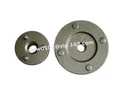

Forging parts play a crucial role in the textile industry, contributing to the efficiency, durability, and precision of textile machinery. As a forging parts supplier, I have witnessed firsthand how these components are integral to the smooth operation of various textile processes. In this blog, I will explore the different forging parts used in the textile industry and their significance.
1. Crankshafts and Connecting Rods
One of the most essential forging parts in textile machinery is the crankshaft and connecting rod assembly. These parts are commonly found in weaving and spinning machines. The crankshaft converts the linear motion of the piston into rotational motion, while the connecting rod transfers the force from the piston to the crankshaft. In weaving machines, they are responsible for the reciprocating motion of the shuttle or the rapier, which is crucial for the interlacing of warp and weft yarns.
Forging is the ideal manufacturing process for crankshafts and connecting rods because it provides high strength and good fatigue resistance. The grain structure of the forged material follows the shape of the part, enhancing its mechanical properties. This is especially important in textile machinery, where these parts are subjected to continuous cyclic loading. For high - quality crankshafts and connecting rods used in textile applications, you can explore China Big Quantity With Low Price Cold Forging.
2. Gears and Sprockets
Gears and sprockets are another set of vital forging parts in the textile industry. They are used to transmit power and motion between different components of textile machines. In spinning machines, gears are used to control the speed and rotation of the spindles, ensuring that the yarn is spun at a consistent rate. Sprockets, on the other hand, are used in conjunction with chains to transfer power in a more efficient and reliable way.
Forged gears and sprockets offer several advantages over their machined or cast counterparts. They have a denser and more uniform structure, which results in better wear resistance and higher load - carrying capacity. This is important in textile machinery, where long - term reliability and accurate motion transmission are required. Our China Professional Forging Parts Manufacturers In Ningbo can provide top - notch gears and sprockets tailored to the specific needs of the textile industry.
3. Shafts
Shafts are fundamental forging parts in textile machinery. They are used to support rotating components such as pulleys, gears, and spindles. In a spinning frame, the main shaft drives the entire system, and its precision and strength are crucial for the quality of the spun yarn. Shafts need to be able to withstand high torsional and bending stresses, as well as the weight of the attached components.
Forging shafts ensures that they have the necessary strength and toughness. The forging process can refine the grain structure of the metal, improving its mechanical properties. This results in shafts that are less likely to fail under the demanding conditions of textile manufacturing. If you are looking for custom - made shafts for your textile machinery, our OEM A105 Aisi1045 Small Steel Metal Forge service can meet your requirements.
4. Hammerheads and Dies
In some textile manufacturing processes, such as the production of certain types of fabrics or the shaping of textile machinery components, hammerheads and dies are used. Hammerheads are used in forging operations to shape the metal parts, while dies provide the desired shape. In the textile industry, these parts are used to manufacture components with specific geometries, such as the frames of textile machines or the parts of knitting machines.
Forged hammerheads and dies are preferred because they can withstand the high impact forces generated during the forging process. They also have good wear resistance, which is important for maintaining the accuracy of the forged parts over time. The quality of these forging parts directly affects the quality and precision of the final textile machinery components.
5. Rollers
Rollers are widely used in the textile industry for various purposes, such as guiding and transporting yarns, fabrics, and other materials. In a calendering machine, rollers are used to press and smooth the fabric, improving its surface finish. In a drawing machine, rollers are used to stretch the fibers to the desired length.


Forged rollers offer excellent surface hardness and smoothness, which are essential for their proper functioning. They can also withstand high pressures and loads without deforming. The forging process allows for the creation of rollers with precise dimensions and a uniform structure, ensuring consistent performance in textile manufacturing.
The Significance of Forging Parts in the Textile Industry
The use of high - quality forging parts in the textile industry has several significant benefits. Firstly, it improves the reliability and durability of textile machinery. Since forging parts have better mechanical properties compared to parts made by other manufacturing processes, they are less likely to fail or wear out quickly. This reduces downtime and maintenance costs for textile manufacturers.
Secondly, forging parts contribute to the precision and quality of textile production. Components such as gears, shafts, and crankshafts need to operate with high accuracy to ensure the consistent production of high - quality yarns and fabrics. The precise dimensions and excellent mechanical properties of forging parts help to achieve this level of precision.
Finally, forging parts can be customized to meet the specific requirements of different textile machinery. As a forging parts supplier, we can work closely with textile manufacturers to design and produce parts that are tailored to their unique needs. This flexibility allows textile manufacturers to optimize their machinery for maximum efficiency and productivity.
Contact for Procurement and Negotiation
If you are a textile manufacturer or involved in the textile industry and are in need of high - quality forging parts, we are here to assist you. We offer a wide range of forging parts, including crankshafts, gears, shafts, and more. Our team of experts can provide technical support and guidance to ensure that you get the right parts for your machinery.
Whether you need standard parts or custom - made components, we have the capabilities to meet your requirements. We are committed to providing high - quality products at competitive prices. Please feel free to reach out to us to start a procurement negotiation. Together, we can enhance the performance and reliability of your textile machinery.
References
- "Textile Machinery Design and Technology" by John Smith
- "Metal Forging: Principles and Applications" by David Brown
- Industry reports on the textile machinery manufacturing sector.