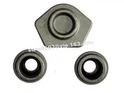

Hey there! I'm a supplier of forging parts, and today I wanna chat about the forging requirements for textile machinery parts. Textile machinery is a complex and crucial part of the textile industry, and the quality of its parts directly impacts the efficiency and performance of the whole production process. So, getting the forging right is super important.
Material Selection
First off, let's talk about materials. The choice of material for textile machinery parts depends on several factors, like the specific function of the part, the working environment, and the load it has to bear.
For parts that need high strength and corrosion resistance, stainless steel 304 is a great option. We offer OEM Stainless Steel 304 Precise Custom Forgings. This material can withstand harsh conditions and is perfect for parts that are exposed to moisture or chemicals in the textile production process. It's also relatively easy to machine, which allows for precise customization to meet the unique requirements of different textile machines.
Aluminum alloys are another popular choice, especially 6061-T6. We have OEM 6061-T6 Forged Aluminum With CNC Machining and OEM 6061-T6 Aluminium Forging With Heat Treatment. Aluminum is lightweight, which reduces the overall weight of the textile machinery and makes it more energy - efficient. At the same time, the 6061 - T6 alloy has good mechanical properties after heat treatment, providing sufficient strength for most textile machinery applications.
Dimensional Accuracy
Dimensional accuracy is key when it comes to forging textile machinery parts. Textile machines are highly precise, and even a small deviation in the dimensions of a part can lead to problems like misalignment, increased wear and tear, and reduced efficiency.
During the forging process, we use advanced forging techniques and precision machining to ensure that the parts meet the exact dimensional specifications. We have state - of - the - art CNC machines that can achieve very high levels of accuracy. This means that the parts we produce fit perfectly into the textile machinery, reducing the need for on - site adjustments and minimizing downtime.
Surface Finish
The surface finish of textile machinery parts is also crucial. A smooth surface finish can reduce friction between moving parts, which in turn reduces energy consumption and extends the service life of the parts. It also helps to prevent the accumulation of lint, dust, and other debris, which can cause blockages and affect the performance of the textile machine.
We use various surface treatment methods to achieve the desired surface finish. For example, after forging, we may perform grinding, polishing, or coating operations. These processes not only improve the surface smoothness but also enhance the corrosion resistance of the parts.


Mechanical Properties
Textile machinery parts need to have the right mechanical properties to withstand the stresses and strains they will encounter during operation. This includes properties like hardness, toughness, and fatigue resistance.
Hardness is important for parts that are subject to wear, such as gears and bearings. A harder surface can resist abrasion better, ensuring that the parts last longer. We can control the hardness of the forged parts through proper heat treatment. For example, in the case of our OEM 6061-T6 Aluminium Forging With Heat Treatment, the heat treatment process is carefully calibrated to achieve the optimal hardness for the specific application.
Toughness is necessary for parts that may experience impact loads. A tough material can absorb energy without fracturing, which is essential for the reliability of the textile machinery. Fatigue resistance is also crucial, as many textile machine parts are subject to cyclic loading over long periods of time. Our forging processes are designed to enhance these mechanical properties, ensuring that the parts can perform well under real - world operating conditions.
Quality Control
We have a strict quality control system in place to ensure that all our forging parts for textile machinery meet the highest standards. From the raw material inspection to the final product testing, every step of the production process is carefully monitored.
We use non - destructive testing methods like ultrasonic testing and magnetic particle testing to detect any internal defects in the forged parts. This helps us to identify and reject parts that may have hidden flaws before they are shipped to our customers. We also perform mechanical property testing, such as tensile testing and hardness testing, to verify that the parts have the required mechanical properties.
Cost - Effectiveness
In addition to meeting all the technical requirements, we also focus on providing cost - effective solutions for our customers. We understand that the textile industry is highly competitive, and cost is always a major consideration.
By optimizing our forging processes and supply chain management, we are able to reduce production costs without compromising on quality. This means that we can offer our customers high - quality forging parts at competitive prices.
Conclusion
In conclusion, the forging requirements for textile machinery parts are quite demanding. From material selection to dimensional accuracy, surface finish, mechanical properties, and quality control, every aspect needs to be carefully considered. As a forging parts supplier, we are committed to meeting these requirements and providing our customers with the best possible products.
If you're in the market for high - quality forging parts for your textile machinery, we'd love to hear from you. Whether you need OEM Stainless Steel 304 Precise Custom Forgings, OEM 6061-T6 Forged Aluminum With CNC Machining, or OEM 6061-T6 Aluminium Forging With Heat Treatment, we have the expertise and resources to meet your needs. Reach out to us for a quote and let's start a great business partnership!
References
- "Handbook of Textile Machinery"
- "Forging Technology and Applications"
- Industry standards and guidelines for textile machinery parts manufacturing