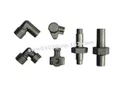

In high - pressure environments, the requirements for forging parts are extremely stringent. As a forging parts supplier, I have witnessed firsthand the critical nature of these requirements in ensuring the safety, reliability, and performance of various applications. This blog post will delve into the key requirements for forging parts in high - pressure environments, drawing on industry knowledge and our experience in supplying high - quality forging parts.
Material Selection
The choice of material is the cornerstone of producing forging parts suitable for high - pressure environments. Materials need to possess high strength, good ductility, and excellent corrosion resistance.
Carbon steels are commonly used in high - pressure forging parts. For instance, 1045, c45, Q235, St37 - 2, Q345 Carbon Steel Forging offers a good balance of strength and machinability. 1045 steel, in particular, has a relatively high carbon content, which contributes to its high tensile strength. This makes it suitable for applications where the forging parts need to withstand high pressures without deformation.
Aluminum alloys are also popular due to their lightweight nature and good corrosion resistance. Professional 6061 - T6 Aluminum Forging Suppliers provide 6061 - T6 aluminum, which has excellent mechanical properties. It can maintain its strength even under high - pressure conditions while reducing the overall weight of the system, which is crucial in aerospace and automotive applications.
Stainless steels are another option, especially when corrosion resistance is of utmost importance. They can withstand harsh chemical environments and high pressures simultaneously, making them suitable for applications in the chemical and oil - and - gas industries.
Dimensional Accuracy
In high - pressure environments, dimensional accuracy is non - negotiable. Even the slightest deviation from the specified dimensions can lead to catastrophic failures. Forging parts must be manufactured to precise tolerances to ensure a proper fit within the system.
Precision forging techniques are employed to achieve the required dimensional accuracy. For example, OEM Aisi1045 Steel Precise Press Forging uses advanced press - forging methods to produce parts with tight tolerances. Computer - aided design (CAD) and computer - aided manufacturing (CAM) technologies are also used to design and manufacture forging parts with high precision.
During the manufacturing process, strict quality control measures are implemented. This includes using advanced measuring tools such as coordinate measuring machines (CMMs) to verify the dimensions of the forging parts. Any parts that do not meet the specified dimensional requirements are rejected to ensure the overall quality of the batch.
Microstructure and Grain Size
The microstructure and grain size of forging parts have a significant impact on their performance in high - pressure environments. A fine - grained microstructure generally provides better mechanical properties, including higher strength and toughness.
During the forging process, proper heat treatment is crucial to control the microstructure and grain size. For example, normalizing, quenching, and tempering are common heat - treatment processes used to refine the grain structure of the forging parts. Normalizing helps to eliminate internal stresses and refine the grain size, while quenching and tempering can further enhance the strength and toughness of the parts.
The forging process itself also affects the microstructure. Controlled deformation during forging can align the grains in a favorable direction, improving the mechanical properties of the parts. For instance, in hot forging, the metal is deformed at high temperatures, which allows for better grain flow and refinement.
Surface Finish
A good surface finish is essential for forging parts in high - pressure environments. A rough surface can act as a stress concentrator, leading to premature failure of the parts. Additionally, a smooth surface finish can reduce friction and wear, improving the overall performance and lifespan of the forging parts.
Various surface - finishing techniques are used to achieve the desired surface quality. Machining operations such as grinding and polishing are commonly employed to remove surface irregularities and improve the surface finish. Coatings can also be applied to enhance the corrosion resistance and reduce friction of the forging parts.
Fatigue Resistance
Forging parts in high - pressure environments are often subjected to cyclic loading, which can lead to fatigue failure. Therefore, high fatigue resistance is a critical requirement.
The material selection, microstructure, and manufacturing process all play a role in determining the fatigue resistance of forging parts. As mentioned earlier, materials with high strength and good ductility are more likely to have better fatigue resistance. A fine - grained microstructure can also improve fatigue resistance by inhibiting crack initiation and propagation.
In addition, proper design of the forging parts can reduce stress concentrations, which is crucial for improving fatigue resistance. Fillets, radii, and smooth transitions are incorporated into the design to minimize stress concentrations at critical points.
Testing and Quality Assurance
Before being delivered to customers, forging parts must undergo rigorous testing and quality assurance procedures. This includes non - destructive testing (NDT) methods such as ultrasonic testing, magnetic particle testing, and dye penetrant testing to detect any internal or surface defects.


Destructive testing methods such as tensile testing, hardness testing, and impact testing are also carried out to verify the mechanical properties of the forging parts. These tests ensure that the parts meet the specified requirements and can perform reliably in high - pressure environments.
As a forging parts supplier, we are committed to meeting the highest standards of quality. Our team of experts uses state - of - the - art equipment and techniques to ensure that every forging part we supply meets the strict requirements for high - pressure environments.
If you are in need of high - quality forging parts for your high - pressure applications, we invite you to reach out to us for a detailed discussion. Our experienced sales team will be happy to assist you in selecting the right forging parts and provide you with competitive pricing and excellent service.
References
- ASM Handbook Committee. (2008). ASM Handbook Volume 14A: Metalworking: Forging. ASM International.
- Dieter, G. E. (1986). Mechanical Metallurgy. McGraw - Hill.
- Kalpakjian, S., & Schmid, S. R. (2010). Manufacturing Engineering and Technology. Pearson.