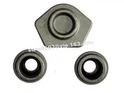

Forging is a manufacturing process that involves shaping metal using compressive forces, typically with the use of a hammer or a press. As a forging parts supplier, we understand the importance of producing high - quality forgings. However, like any manufacturing process, forging is not without its challenges. There are several typical defects that can occur in forging parts, and in this blog, we will discuss these defects and how to prevent them.
Typical Defects in Forging Parts
1. Cracks
Cracks are one of the most common and serious defects in forging parts. They can occur on the surface or inside the forging. Surface cracks are usually visible and can be caused by a variety of factors. For example, if the forging temperature is too low, the metal may not be malleable enough, and the stress during forging can lead to cracking. High - speed forging with improper die design can also cause excessive stress concentration on the surface of the part, resulting in surface cracks.
Internal cracks are more difficult to detect. They can be due to improper forging ratios, which means that the deformation of the metal during forging is not uniform. When the forging ratio is too large or too small, the internal structure of the metal may be damaged, leading to the formation of internal cracks. Another cause of internal cracks is the presence of impurities in the metal. Impurities can act as stress concentrators, and under the action of forging forces, cracks may initiate and propagate inside the part.
2. Porosity
Porosity refers to the presence of small holes or voids in the forging. It can occur when the metal is not properly consolidated during the forging process. One of the main reasons for porosity is the presence of gas in the molten metal before forging. If the gas is not removed during melting or casting, it will be trapped in the metal during forging, forming pores. Another cause is the improper filling of the die. If the metal does not flow evenly into all parts of the die cavity, there may be areas where the metal is not fully compacted, resulting in porosity.
3. Cold Shut
Cold shut is a defect that occurs when two streams of metal meet during forging but do not fully fuse together. This can happen when the forging temperature is too low, and the metal loses its fluidity. As a result, when two parts of the metal come into contact, they do not bond properly, leaving a visible seam or line on the surface of the forging. Cold shut can also be caused by improper die design. If the die has sharp corners or sudden changes in cross - section, the metal flow may be disrupted, leading to the formation of cold shuts.
4. Scale Inclusions
Scale is a layer of oxidized metal that forms on the surface of the metal when it is heated. During forging, if the scale is not removed before the metal is deformed, it can be pressed into the surface of the forging, forming scale inclusions. Scale inclusions can reduce the surface quality of the forging and may also affect its mechanical properties. They can act as stress raisers, increasing the likelihood of cracking under load.
5. Unfilled Sections
Unfilled sections occur when the metal does not completely fill the die cavity during forging. This can be due to insufficient material being used, improper die design, or low forging pressure. If the amount of metal placed in the die is too small, it will not be able to fill the entire cavity. An improper die design, such as a cavity with a complex shape or a narrow passage, can also prevent the metal from flowing freely and filling all areas. Low forging pressure may not be enough to force the metal to fill the die completely.
Preventive Measures
1. Crack Prevention
- Optimal Forging Temperature: We need to carefully control the forging temperature. Each type of metal has an optimal forging temperature range. For example, for steel, the forging temperature is usually between 800 - 1200°C. By maintaining the forging temperature within this range, the metal will have good plasticity and can be deformed without cracking. We use advanced temperature control systems to monitor and adjust the temperature during the forging process.
- Proper Forging Ratio: Determine the appropriate forging ratio based on the type of metal and the requirements of the part. We conduct detailed calculations and simulations to ensure that the forging ratio is within the acceptable range, which helps to achieve uniform deformation of the metal and reduces the risk of internal cracks.
- Impurity Control: Source high - quality raw materials and use proper melting and refining processes to reduce the content of impurities in the metal. We work closely with our suppliers to ensure that the raw materials meet our strict quality standards.
2. Porosity Prevention
- Gas Removal: During the melting process, we use degassing techniques to remove gas from the molten metal. This can be achieved by using vacuum melting or adding degassing agents. By reducing the gas content in the metal, we can significantly reduce the formation of porosity.
- Proper Die Filling: Optimize the die design to ensure smooth metal flow. We use computer - aided design (CAD) and simulation software to analyze the metal flow in the die cavity and make necessary adjustments to the die shape. Additionally, we ensure that the correct amount of metal is used for each forging operation to guarantee complete filling of the die.
3. Cold Shut Prevention
- Maintain Adequate Temperature: Keep the forging temperature high enough to ensure good fluidity of the metal. We use pre - heating and in - process heating methods to prevent the metal from cooling too quickly during forging.
- Improve Die Design: Design the die with smooth contours and avoid sharp corners or sudden changes in cross - section. This helps to promote smooth metal flow and reduces the likelihood of cold shuts.
4. Scale Inclusion Prevention
- Scale Removal: Before forging, we use descaling methods such as shot blasting or acid pickling to remove the scale from the surface of the metal. This ensures that no scale is pressed into the forging during the deformation process.
5. Unfilled Section Prevention
- Accurate Material Calculation: Calculate the exact amount of material required for each forging based on the volume of the die cavity. We use precise measuring and weighing equipment to ensure the correct amount of metal is used.
- Sufficient Forging Pressure: Select the appropriate forging equipment and set the forging pressure according to the requirements of the part. We regularly calibrate our forging equipment to ensure that it can provide the necessary pressure to fill the die completely.
Our Advantages as a Forging Parts Supplier
As a forging parts supplier, we have a team of experienced engineers and technicians who are well - versed in the forging process. We use state - of - the - art equipment and advanced manufacturing techniques to produce high - quality forging parts. Our quality control system is strict, and we conduct multiple inspections at every stage of the manufacturing process to ensure that the final products meet or exceed our customers' expectations.


We offer a wide range of forging parts, including those made from different types of metals such as aluminum, steel, and titanium. If you are looking for Professional 6061 - T6 Aluminum Forging Suppliers, we have the expertise and resources to provide you with top - quality products. Our High Quality Aluminum Forging Manufacturers use advanced aluminum forging processes to ensure the best performance of the parts. And for those interested in the Professional Metal Forging Process, we can offer detailed information and high - quality forged products.
Contact Us for Procurement
If you are in need of high - quality forging parts, we invite you to contact us for procurement. We are committed to providing you with excellent products and services. Our team is ready to discuss your specific requirements and offer customized solutions. Whether you need a small batch of prototypes or a large - scale production run, we can meet your needs.
References
- ASM Handbook Committee, ASM Handbook Volume 14A: Metalworking: Forging, ASM International, 2013.
- Dieter, G. E., Mechanical Metallurgy, McGraw - Hill, 1986.
- Kalpakjian, S., & Schmid, S. R., Manufacturing Engineering and Technology, Pearson, 2014.