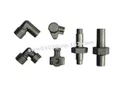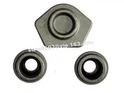

Stress concentration is a crucial concept in the realm of CNC machining parts. As a reliable supplier of high - quality CNC machining parts, understanding the stress - concentration factor is of utmost significance for both us and our customers. In this blog, we will delve deep into what the stress - concentration factor is, why it matters in CNC machining, and how it impacts the performance and durability of the parts we manufacture.
What is the Stress - Concentration Factor?
The stress - concentration factor, often denoted as (K_t), is a dimensionless quantity. It is defined as the ratio of the maximum stress ((\sigma_{max})) at a point of stress concentration to the nominal stress ((\sigma_{nom})) in the absence of the stress - raising feature. Mathematically, it is expressed as (K_t=\frac{\sigma_{max}}{\sigma_{nom}}).


In a real - world scenario, when a load is applied to a CNC machining part, the distribution of stress is not always uniform. There are certain geometric features such as holes, notches, fillets, and sudden changes in cross - section that can cause the stress to be concentrated in a particular area. For example, consider a flat bar with a circular hole in the middle. When a tensile load is applied to the bar, the stress around the hole will be much higher than the stress in the rest of the bar away from the hole. The stress - concentration factor helps us quantify this increase in stress.
Why is the Stress - Concentration Factor Important in CNC Machining?
Impact on Part Strength and Durability
In CNC machining, we strive to produce parts that can withstand the intended loads and operating conditions. A high stress - concentration factor can significantly reduce the strength of a part. When the stress at a point of concentration exceeds the material's yield strength, plastic deformation can occur, leading to premature failure of the part. For instance, in a mechanical component that experiences cyclic loading, such as a shaft in a motor, a high stress - concentration factor can accelerate fatigue crack initiation and propagation, ultimately resulting in the breakdown of the component.
Design Optimization
Understanding the stress - concentration factor allows us to optimize the design of CNC machining parts. By carefully choosing the geometry and dimensions of the part, we can minimize the stress - concentration factor. For example, using a larger fillet radius at the corners of a part can reduce the stress concentration compared to a sharp corner. This not only improves the part's performance but also reduces the risk of failure, which is crucial for applications where safety and reliability are paramount.
Material Selection
The stress - concentration factor also influences material selection. Different materials have different abilities to withstand stress concentrations. For example, ductile materials such as aluminum and some steels can tolerate higher stress concentrations better than brittle materials like ceramics. When designing a CNC machining part, we need to take into account the expected stress - concentration factor and choose a material that can handle it without failing.
Factors Affecting the Stress - Concentration Factor in CNC Machining Parts
Geometric Features
As mentioned earlier, geometric features play a major role in determining the stress - concentration factor. Holes, notches, and fillets are common stress - raisers. The size, shape, and location of these features can have a significant impact on the stress - concentration factor. For example, a larger hole in a plate will generally result in a higher stress - concentration factor compared to a smaller hole. Similarly, a sharp notch will cause a higher stress concentration than a rounded notch.
Loading Conditions
The type of loading applied to the part also affects the stress - concentration factor. Tensile, compressive, and shear loads can all lead to different stress - concentration patterns. For example, in a part under bending load, the stress - concentration factor at the outer fibers of the part will be different from that under a tensile load. Cyclic loading, such as that experienced by a gear in a transmission system, can also have a more pronounced effect on the stress - concentration factor due to the fatigue mechanism.
Material Properties
The mechanical properties of the material, such as its yield strength, ultimate strength, and ductility, can influence the stress - concentration factor. A material with high ductility can deform plastically at the point of stress concentration, redistributing the stress and reducing the effective stress - concentration factor. In contrast, a brittle material may crack immediately when the stress at the concentration point exceeds its strength.
Measuring and Analyzing the Stress - Concentration Factor
Experimental Methods
One way to measure the stress - concentration factor is through experimental testing. This can involve using strain gauges attached to the surface of the part to measure the local strain, which can then be used to calculate the stress. By comparing the maximum stress measured at the point of stress concentration with the nominal stress, the stress - concentration factor can be determined. However, experimental methods can be time - consuming and expensive, especially for complex parts.
Numerical Methods
Numerical methods, such as finite element analysis (FEA), are widely used to analyze the stress - concentration factor in CNC machining parts. FEA software allows us to create a virtual model of the part and apply the appropriate loads and boundary conditions. The software then calculates the stress distribution throughout the part, including the stress concentration at specific points. This method is more cost - effective and efficient than experimental testing, especially for parts with complex geometries.
Our Approach as a CNC Machining Parts Supplier
At our company, we take the stress - concentration factor seriously in every aspect of our CNC machining process.
Design Consultation
We offer design consultation services to our customers. Our experienced engineers work closely with customers to understand their requirements and design parts that minimize the stress - concentration factor. By using advanced design tools and our in - depth knowledge of stress concentration, we can optimize the part geometry to ensure maximum strength and durability.
Material Expertise
We have a wide range of materials available for CNC machining, including stainless steel 304, stainless steel 303, and various alloys. We can help our customers select the most appropriate material based on the expected stress - concentration factor and the application requirements. For example, if a part is expected to experience high stress concentrations and cyclic loading, we may recommend a high - strength alloy with good ductility.
Quality Control
During the manufacturing process, we implement strict quality control measures. We use FEA to analyze the stress - concentration factor of the parts before production and conduct regular inspections during the machining process. This ensures that the parts meet the required specifications and have a low risk of failure due to stress concentration.
Related CNC Machining Services We Offer
We specialize in several CNC machining services that are relevant to the production of high - quality parts considering stress - concentration factors.
- Stainless Steel 304 CNC Custom Machining: Stainless steel 304 is a popular material for CNC machining due to its excellent corrosion resistance and mechanical properties. Our custom machining services ensure that the parts are designed and manufactured to minimize stress concentration.
- China Competitive Price CNC Lathe Components: We offer competitive - priced CNC lathe components. Our advanced lathe machining technology allows us to produce parts with precise geometries, reducing the stress - concentration factor and improving the part's performance.
- OEM Stainless Steel 303 CNC Lathe Services: We provide OEM services for stainless steel 303 CNC lathe parts. Our team of experts can work with you to develop custom solutions that meet your specific requirements while taking into account the stress - concentration factor.
If you are in need of high - quality CNC machining parts with a focus on minimizing stress concentration, we invite you to get in touch with us. Our dedicated team is ready to assist you with your procurement needs, provide detailed technical information, and discuss how we can meet your specific requirements. Whether you are in the automotive, aerospace, or any other industry, we have the expertise and resources to deliver the best CNC machining parts for your applications.
References
- Peterson, R. E. (1974). Stress - Concentration Factors. Wiley - Interscience.
- Dowling, N. E. (2012). Mechanical Behavior of Materials: Engineering Methods for Deformation, Fracture, and Fatigue. Pearson.
- Budynas, R. G., & Nisbett, J. K. (2011). Shigley's Mechanical Engineering Design. McGraw - Hill.