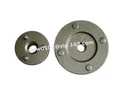

Forging is a manufacturing process where metal is shaped by applying compressive forces, typically using a hammer or a press. As a forging parts supplier, I've witnessed firsthand how the forging temperature plays a pivotal role in determining the properties of the final parts. In this blog post, I'll delve into the science behind how forging temperature affects the properties of parts and why it's crucial for both manufacturers and end - users.
1. Basics of Forging Temperature
Forging can be classified into three main temperature ranges: cold forging, warm forging, and hot forging. Cold forging is carried out at room temperature or slightly above, warm forging occurs between room temperature and the recrystallization temperature of the metal, and hot forging is done above the recrystallization temperature.
The recrystallization temperature is a critical parameter. When a metal is deformed above this temperature, new strain - free grains form, which can significantly alter the mechanical properties of the metal. Different metals have different recrystallization temperatures. For example, for steel, the recrystallization temperature is typically around 600 - 700°C.
2. Influence on Mechanical Properties
2.1 Hardness
Cold forging generally results in increased hardness. When metal is deformed at low temperatures, dislocations (defects in the crystal structure) are created and accumulate. These dislocations impede the movement of other dislocations, making the metal harder. For instance, in cold - forged carbon steel parts, the hardness can be significantly higher compared to the same steel in its annealed state.
On the other hand, hot forging can lead to a more uniform grain structure. If the forging temperature is well - controlled above the recrystallization temperature, the metal can recrystallize during the forging process, resulting in a finer and more uniform grain size. A finer grain size often leads to a balance between hardness and ductility. Warm forging can also achieve a certain level of hardness improvement, but it is usually less pronounced than cold forging.
2.2 Strength
Strength is closely related to hardness. Cold - forged parts often have high yield strength and ultimate tensile strength due to the work - hardening effect. The accumulated dislocations make it more difficult for the metal to deform plastically. However, cold - forged parts may be more brittle, which can be a drawback in applications where impact resistance is required.
Hot - forged parts can have excellent strength as well. The recrystallization process during hot forging can eliminate internal stresses and create a more homogeneous structure. This can result in high - strength parts with good ductility. For example, OEM A105 Aisi1045 Small Steel Metal Forge when hot - forged, can achieve the right balance of strength and ductility for various industrial applications.
2.3 Ductility
Ductility refers to the ability of a material to deform plastically before fracturing. Cold - forged parts usually have lower ductility because of the high dislocation density and work - hardening. The metal becomes more brittle and is more likely to fracture under stress.


Hot forging, when performed correctly, can enhance ductility. The recrystallization process creates a more uniform and strain - free grain structure, allowing the metal to deform more easily. This is crucial for parts that need to undergo further processing or are subjected to dynamic loads. For example, 1045, c45, Q235, St37 - 2, Q345 Carbon Steel Forging parts that are hot - forged can exhibit better ductility, making them suitable for applications such as automotive components.
3. Impact on Microstructure
3.1 Grain Size
As mentioned earlier, forging temperature has a significant impact on grain size. Cold forging typically does not change the grain size significantly, but it can cause grain elongation and distortion. This can lead to anisotropic properties, where the mechanical properties vary depending on the direction of the applied load.
Hot forging, when the temperature is maintained within the appropriate range, promotes recrystallization. The new grains that form are often finer and more equiaxed. A finer grain size is generally beneficial as it improves strength, ductility, and toughness. For example, in large - scale forging operations like Large Dimension Q235 Carbon Steel Open Die Forging, controlling the forging temperature to achieve a fine grain size is crucial for the overall performance of the part.
3.2 Phase Transformations
Some metals can undergo phase transformations during forging depending on the temperature. For example, in steel, when forged at high temperatures, the austenite phase is stable. As the steel cools after forging, the austenite can transform into different phases such as ferrite, pearlite, bainite, or martensite, depending on the cooling rate.
If the forging temperature is too high or the cooling is not properly controlled, undesirable phases may form. For instance, rapid cooling of high - carbon steel from a high forging temperature can result in the formation of martensite, which is very hard but also extremely brittle. This can lead to cracking and premature failure of the part.
4. Effects on Surface Finish and Dimensional Accuracy
4.1 Surface Finish
Cold forging can produce parts with a good surface finish. Since the metal is deformed at low temperatures, there is less oxidation and scaling on the surface. This is beneficial for parts where a smooth surface is required, such as precision components.
Hot forging, however, can lead to surface oxidation and scaling due to the high temperatures. Special measures need to be taken to minimize these effects, such as using protective coatings or performing descaling operations after forging. Warm forging can offer a compromise between the surface finish of cold and hot forging.
4.2 Dimensional Accuracy
Cold forging generally provides better dimensional accuracy. The low - temperature deformation results in less thermal expansion and contraction, which means the final part dimensions are closer to the desired specifications. In hot forging, the thermal expansion and contraction during heating and cooling can cause dimensional variations. Precise temperature control and appropriate allowances need to be made to ensure the required dimensional accuracy.
5. Considerations for Forging Temperature Selection
When selecting the forging temperature, several factors need to be considered. The type of metal is the most obvious one. Different metals have different recrystallization temperatures and respond differently to forging at various temperatures.
The design of the part also plays a role. Complex - shaped parts may require hot forging to ensure proper filling of the die cavity. If high strength and hardness are the primary requirements, cold forging may be a better choice, but the brittleness issue needs to be addressed.
Cost is another important factor. Cold forging usually requires more powerful equipment due to the higher forces involved, but it may reduce the need for post - forging heat treatment. Hot forging may require additional energy for heating, but it can produce parts with better overall properties in some cases.
6. Conclusion and Call to Action
In conclusion, the forging temperature has a profound impact on the properties of forging parts. As a forging parts supplier, we understand the importance of carefully controlling the forging temperature to meet the specific requirements of our customers. Whether you need parts with high hardness, excellent ductility, or precise dimensional accuracy, we can tailor the forging process to your needs.
If you are in the market for high - quality forging parts, we invite you to reach out to us for a detailed discussion. We have the expertise and experience to provide you with the best solutions for your forging needs.
References
- Dieter, G. E. (1986). Mechanical Metallurgy. McGraw - Hill.
- Kalpakjian, S., & Schmid, S. R. (2008). Manufacturing Engineering and Technology. Pearson Prentice Hall.
- ASM Handbook Volume 14A: Metalworking: Forging. ASM International.