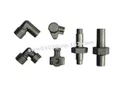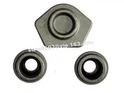

Hey there! I'm a supplier of forging parts, and I've seen firsthand how crucial it is to pick the right forging method for different parts. In this blog, I'll share some tips on how to make that choice, based on my years of experience in the industry.
Understanding the Basics of Forging
Before we dive into how to choose the appropriate forging method, let's quickly go over what forging is. Forging is a manufacturing process where metal is shaped by applying compressive forces. This can be done using a hammer, press, or other tools. The main advantage of forging is that it can improve the mechanical properties of the metal, like strength and toughness.
There are several types of forging methods, each with its own pros and cons. The most common ones are open-die forging, closed-die forging, and seamless rolled ring forging.


Open-Die Forging
Open-die forging is a process where the metal is placed between two flat or shaped dies, and the force is applied to deform the metal. This method is great for producing simple shapes like bars, shafts, and discs. It's also suitable for small production runs because it doesn't require expensive dies. However, open-die forging has lower precision compared to other methods, and it may need additional machining to achieve the desired final shape.
Closed-Die Forging
Closed-die forging, also known as impression-die forging, involves placing the metal in a die cavity that has the desired shape of the final part. The die is then closed, and the metal is forced to fill the cavity. This method can produce complex shapes with high precision and good surface finish. It's ideal for large production runs because the cost per part decreases as the quantity increases. But, the initial cost of making the dies can be quite high.
Seamless Rolled Ring Forging
Seamless rolled ring forging is used to produce ring-shaped parts. The process starts with a round billet, which is pierced to create a hole. Then, the ring is rolled between a pair of rolls to increase its diameter and reduce its thickness. This method produces rings with excellent mechanical properties and a seamless structure. It's commonly used in industries like aerospace, automotive, and energy.
Factors to Consider When Choosing a Forging Method
Now that we know the different forging methods, let's talk about the factors you should consider when choosing the right one for your parts.
Part Complexity
The complexity of the part is one of the most important factors. If your part has a simple shape, like a cylinder or a block, open-die forging might be a good choice. It's cost-effective and can handle basic shapes easily. On the other hand, if your part has a complex shape with intricate details, closed-die forging is probably the way to go. It can reproduce the shape accurately and consistently. For example, if you need a custom-shaped gear, closed-die forging would be more suitable than open-die forging.
Production Volume
The number of parts you need to produce also plays a significant role in choosing the forging method. For small production runs (less than 100 parts), open-die forging is often the best option because it doesn't require expensive dies. You can get your parts made quickly and at a reasonable cost. However, if you're planning to produce a large number of parts (more than 1000 parts), closed-die forging becomes more economical. The initial investment in the dies will be offset by the lower cost per part in the long run.
Material Type
Different metals have different properties, and some forging methods work better with certain materials than others. For example, aluminum alloys are relatively soft and can be easily forged using closed-die forging. You can check out our OEM 6061-T6 Aluminium Forging With Heat Treatment for high-quality aluminum forging parts. Steel, on the other hand, can be forged using various methods, depending on its composition and the desired properties. Our Custom Fabrication Carbon Steel Hot Forging Parts are made using advanced forging techniques to ensure the best quality.
Mechanical Properties
The mechanical properties required for the part, such as strength, hardness, and toughness, also influence the choice of forging method. For parts that need high strength and toughness, like those used in heavy machinery or aerospace applications, closed-die forging or seamless rolled ring forging may be preferred. These methods can produce parts with better grain structure and mechanical properties compared to open-die forging.
Cost
Cost is always a consideration in any manufacturing process. You need to balance the initial investment in the forging method (like die costs) with the cost per part. As mentioned earlier, open-die forging is more cost-effective for small production runs, while closed-die forging is better for large production runs. You also need to factor in the cost of additional machining, heat treatment, and finishing operations.
Our Forging Services
As a forging parts supplier, we offer a wide range of forging services using different methods. Our Professional Metal Forging Process ensures that we can produce high-quality parts according to your specifications. Whether you need simple open-die forging parts or complex closed-die forging components, we've got you covered.
We have a team of experienced engineers and technicians who can help you choose the most appropriate forging method for your parts. We'll work closely with you to understand your requirements, provide cost estimates, and ensure that the final parts meet your expectations.
Conclusion
Choosing the appropriate forging method for your parts is a crucial decision that can affect the quality, cost, and production time of your products. By considering factors like part complexity, production volume, material type, mechanical properties, and cost, you can make an informed choice. If you're looking for a reliable forging parts supplier, don't hesitate to reach out to us. We're here to help you with all your forging needs.
References
- ASM Handbook Volume 14A: Metalworking: Forging, ASM International
- Forging Technology Handbook, CRC Press