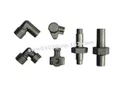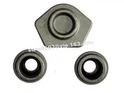

Hey there! I'm a supplier of forging parts, and today I wanna chat about the forging operations for pin parts. Pins are super common in all sorts of industries, from automotive to machinery, and getting the forging right is crucial for their performance.
Let's start with the basics. Forging is a manufacturing process where metal is shaped by applying compressive forces, usually with the help of a hammer or a press. When it comes to pin parts, there are several key forging operations that we use to turn raw metal into high - quality pins.
1. Billet Preparation
The first step in forging pin parts is billet preparation. A billet is a piece of metal that's cut to the right size and shape for forging. We select the appropriate metal based on the requirements of the pin. For example, if the pin needs to be strong and durable, we might choose carbon steel. Check out our 1045 ,c45,Q235, St37 - 2, Q345 Carbon Steel Forging options. These carbon steels are great for pins that need to withstand heavy loads.
We cut the billet from a larger piece of metal using saws or shears. The size of the billet is carefully calculated to ensure that there's enough material for the forging process but not too much to cause waste. After cutting, we might also perform some heat treatment on the billet to make it more malleable for forging.


2. Heating
Once the billet is ready, it's time to heat it up. Heating the metal is essential because it makes it softer and easier to shape. We heat the billet in a furnace to a specific temperature depending on the type of metal. For most carbon steels, the forging temperature ranges from around 900°C to 1200°C.
Heating the billet evenly is crucial. If the temperature is too low, the metal won't be malleable enough, and it might crack during forging. On the other hand, if the temperature is too high, the metal can lose its strength and develop defects. We use advanced temperature control systems to make sure the billet is heated to the perfect temperature.
3. Upsetting
Upsetting is one of the primary forging operations for pin parts. In this process, we increase the cross - sectional area of the billet at one end while reducing its length. This is usually done by placing the heated billet between two dies and applying a compressive force.
For pin parts, upsetting is often used to create the head of the pin. The force applied during upsetting causes the metal to flow and take the shape of the die. We can control the size and shape of the upset by adjusting the force and the design of the dies. This operation is really important because it gives the pin its characteristic shape and provides a solid base for the rest of the forging process.
4. Piercing
If the pin needs to have a hole in it, we use a piercing operation. After upsetting, when the metal is still hot and malleable, we insert a punch into the billet to create the hole. The size and depth of the hole are determined by the requirements of the pin.
Piercing requires precise control to ensure that the hole is straight and has the right dimensions. We use high - quality punches and dies to make sure the piercing process is accurate. This operation is common in pins that are used for fastening or connecting other parts, as the hole allows for the insertion of a bolt or a rivet.
5. Drawing Out
Drawing out is the opposite of upsetting. In this operation, we reduce the cross - sectional area of the billet while increasing its length. This is done by applying a pulling or stretching force to the metal.
For pin parts, drawing out is used to create the shank of the pin. We use dies with a tapered shape to gradually reduce the diameter of the billet and make it longer. This operation helps to refine the grain structure of the metal, which improves the strength and toughness of the pin.
6. Trimming
After the main forging operations are completed, the pin part usually has some excess material around the edges. This excess material, called flash, is removed through a trimming operation.
We use trimming dies to cut off the flash. Trimming is important because it gives the pin a clean and precise shape. It also helps to improve the surface finish of the pin, which is important for its appearance and performance.
7. Heat Treatment
Once the forging and trimming are done, the pin part undergoes heat treatment. Heat treatment is used to improve the mechanical properties of the pin, such as its hardness, strength, and toughness.
There are different types of heat treatment processes, such as annealing, quenching, and tempering. Annealing is used to soften the metal and relieve internal stresses. Quenching involves rapidly cooling the metal to increase its hardness, and tempering is done after quenching to reduce the brittleness and improve the toughness.
The choice of heat treatment depends on the type of metal and the requirements of the pin. For example, if the pin needs to be very hard and wear - resistant, we might use a quenching and tempering process.
8. Surface Finishing
The final step in the forging process for pin parts is surface finishing. Surface finishing is done to improve the appearance of the pin and protect it from corrosion.
We can use different surface finishing techniques, such as grinding, polishing, or coating. Grinding is used to remove any rough spots on the surface of the pin and give it a smooth finish. Polishing can further enhance the smoothness and shine of the pin. Coating, such as galvanizing or painting, can provide a protective layer that prevents the pin from rusting.
Now, let's talk about the materials we use for pin parts. As I mentioned earlier, carbon steel is a popular choice because of its strength and affordability. But we also offer other materials, such as aluminum. Aluminum is lightweight and has good corrosion resistance. Check out our High Quality Aluminum Forging Manufacturers page to see our aluminum forging options.
We also have experience in custom forging of aluminum and stainless steel. If you have specific requirements for your pin parts, our Custom 7year Experience Aluminum And Stainless Steel Forging Company can work with you to create the perfect solution.
If you're in the market for high - quality forging pin parts, we're here to help. We have the expertise and the equipment to produce pins that meet your exact specifications. Whether you need a small batch for a prototype or a large quantity for mass production, we can handle it.
Contact us to start a discussion about your forging needs. We're always happy to answer your questions and provide you with a quote. Let's work together to get you the best forging pin parts for your project.
References
- Smith, J. (2018). Forging Technology Handbook. New York: Industrial Press.
- Davis, R. (2019). Metal Forming Processes. London: Elsevier.
- Johnson, M. (2020). Heat Treatment of Metals. Chicago: McGraw - Hill.