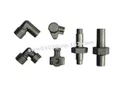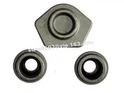

Hey there! I'm a supplier of CNC machining parts, and let me tell you, producing complex - shaped CNC machining parts is no walk in the park. There are a bunch of common challenges that we face on a regular basis. In this blog, I'll share some of these challenges with you and give you an idea of what goes on behind the scenes in the world of CNC machining.
Material Selection
One of the first challenges we encounter is choosing the right material for the complex - shaped parts. Different materials have different properties, and these properties can significantly affect the machining process. For example, if we're making OEM Polished AA6061 - T6 CNC Milling Parts, we need to consider the strength, corrosion resistance, and machinability of AA6061 - T6 aluminum alloy.
Some materials are harder to machine than others. Harder materials like stainless steel can cause excessive tool wear, which means we have to change the cutting tools more frequently. This not only increases the cost but also slows down the production process. On the other hand, softer materials may deform easily during machining, leading to inaccurate part dimensions. So, it's crucial to strike a balance and select a material that meets the part's performance requirements while being relatively easy to machine.


Tooling and Cutting Parameters
The choice of cutting tools and the setting of cutting parameters are also major challenges. When dealing with complex - shaped parts, we need specialized tools that can reach tight corners and create intricate geometries. For instance, ball - nose end mills are often used for machining curved surfaces, while drill bits are used for creating holes.
Selecting the right cutting speed, feed rate, and depth of cut is essential for achieving high - quality parts. If the cutting speed is too high, the tool may overheat and wear out quickly. If the feed rate is too fast, it can cause poor surface finish or even break the tool. And if the depth of cut is too large, it can put excessive stress on the part and the machine, leading to dimensional inaccuracies.
We often have to conduct multiple tests to find the optimal cutting parameters for each specific part. This trial - and - error process can be time - consuming and costly, especially when dealing with complex geometries.
Fixturing and Workholding
Another challenge is fixturing and workholding. Complex - shaped parts are not easy to hold securely during machining. If the part moves or vibrates during the cutting process, it can result in poor surface finish, inaccurate dimensions, and even part rejection.
We need to design custom fixtures that can hold the part firmly in place while still allowing the cutting tools to access all the necessary areas. These fixtures need to be precise and durable. For example, when machining Q235 Mild Steel Nickle Plated CNC Spare Parts, we have to ensure that the mild steel part is held tightly to prevent any movement during the nickel - plating and machining processes.
Designing and manufacturing these custom fixtures can be expensive and time - consuming. Additionally, we need to make sure that the fixtures can be easily adjusted and reused for different parts, which adds another layer of complexity to the process.
Programming and CAM Software
Programming is a critical aspect of CNC machining, especially for complex - shaped parts. We use Computer - Aided Manufacturing (CAM) software to generate the toolpaths for the CNC machine. However, programming complex geometries can be extremely challenging.
The CAM software needs to take into account various factors such as the part's shape, the cutting tools, and the machining operations. For example, when creating the program for OEM Stainless Steel 304L CNC Lathe Turning, we have to consider the rotation of the lathe, the cutting tool's movement, and the surface finish requirements.
Even a small error in the programming can lead to significant problems during machining. We need to thoroughly simulate the machining process using the CAM software to detect and correct any potential issues before sending the program to the CNC machine. This requires a high level of skill and experience from our programming team.
Quality Control
Quality control is a constant challenge in the production of complex - shaped CNC machining parts. We need to ensure that each part meets the strict dimensional and surface finish requirements. This involves using advanced measurement tools such as coordinate measuring machines (CMMs) and optical inspection systems.
Inspecting complex - shaped parts can be difficult because of their intricate geometries. Some areas may be hard to access with the measurement tools, and it can be challenging to accurately measure certain features. For example, measuring the internal diameter of a small, deep hole or the surface roughness of a curved surface requires specialized techniques and equipment.
We also need to have a rigorous quality control process in place to catch any defects early in the production process. This includes in - process inspections at various stages of machining and a final inspection before the parts are shipped to the customer.
Cost Management
Cost management is always a concern in the manufacturing industry, and it's especially challenging when producing complex - shaped CNC machining parts. As we've discussed, there are many factors that can increase the cost, such as tool wear, custom fixture design, and quality control.
We need to find ways to reduce costs without sacrificing the quality of the parts. This may involve optimizing the machining process, negotiating better prices with suppliers, or finding more efficient ways to use materials. For example, we can try to minimize the amount of scrap material by improving the nesting of parts on the raw material sheets.
However, it's a delicate balance. Cutting costs too much can lead to lower - quality parts, which can damage our reputation and lead to customer dissatisfaction.
Conclusion
Producing complex - shaped CNC machining parts is filled with challenges, from material selection to cost management. But despite these difficulties, we're committed to providing high - quality parts to our customers. We continuously invest in new technologies, train our staff, and improve our processes to overcome these challenges.
If you're in the market for CNC machining parts, whether it's for OEM Polished AA6061 - T6 CNC Milling Parts, Q235 Mild Steel Nickle Plated CNC Spare Parts, or OEM Stainless Steel 304L CNC Lathe Turning, we'd love to have a chat with you. We can discuss your specific requirements, provide you with a quote, and work together to find the best solutions for your project. Contact us today to start the procurement process and let's make your CNC machining needs a reality.
References
- “CNC Machining Handbook.” Machining Industry Press, 2020.
- “Advanced Materials for CNC Machining.” Materials Science Journal, Vol. 15, 2021.
- “Quality Control in Precision Manufacturing.” Manufacturing Technology Review, Vol. 22, 2022.