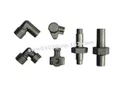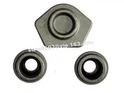

Hey there! I'm a supplier of forging parts, and today I wanna chat about the standards for dimensional accuracy of forging parts. Dimensional accuracy is super crucial in the forging industry. It can make or break the performance and functionality of the final product. So, let's dive right in and explore what these standards are all about.


First off, what do we mean by dimensional accuracy in forging parts? Well, it refers to how closely the actual dimensions of a forged part match the specified dimensions in the design. When we're talking about dimensions, we're looking at things like length, width, height, diameter, and angles. Any deviation from the design specs can lead to problems down the line, like parts not fitting together properly or not performing as intended.
There are several factors that can affect the dimensional accuracy of forging parts. One of the main ones is the forging process itself. Different forging methods, such as open - die forging, closed - die forging, and impression - die forging, have different levels of control over the final dimensions. Open - die forging, for example, is more suitable for large and simple shapes, but it might have a bit more variability in dimensions compared to closed - die forging. Closed - die forging, on the other hand, can produce parts with very high dimensional accuracy because the metal is forced into a specific die cavity.
The material being forged also plays a big role. Some metals are more malleable than others, which means they can be shaped more easily during the forging process. For instance, aluminum is generally easier to forge than steel, and it can achieve higher dimensional accuracy in some cases. But steel has its own advantages, like strength and durability.
Now, let's talk about some of the standards for dimensional accuracy. In most industries, there are international and national standards that define the acceptable tolerances for forging parts. Tolerance is basically the allowable amount of deviation from the specified dimension. For example, if a part is designed to have a diameter of 50mm, the tolerance might be ±0.1mm. This means that the actual diameter of the forged part can be anywhere between 49.9mm and 50.1mm and still be considered acceptable.
The ISO (International Organization for Standardization) has a set of standards related to forging, which cover aspects like dimensional tolerances, surface finish, and material properties. These standards are widely recognized and followed around the world. In addition to ISO standards, there are also industry - specific standards. For example, the automotive industry has its own set of strict requirements for the dimensional accuracy of forging parts used in engines, transmissions, and other critical components.
Another important aspect is the inspection and measurement of forging parts. To ensure that the parts meet the dimensional accuracy standards, we use a variety of measuring tools. Calipers, micrometers, and coordinate measuring machines (CMMs) are some of the commonly used tools. Calipers are great for quick and simple measurements, while CMMs are highly accurate and can measure complex shapes and geometries.
At our company, we take dimensional accuracy very seriously. We have a team of experienced engineers and quality control experts who are constantly monitoring the forging process to make sure that the parts we produce meet the highest standards. We use state - of - the - art measuring equipment to inspect every part before it leaves our facility.
If you're in the market for high - quality forging parts, we've got you covered. We offer a wide range of forging products, including OEM A105 Aisi1045 Small Steel Metal Forge, OEM Carbon Steel Q235 St37 - 2 C45 1010 Forged Steel, and Professional 6061 - T6 Aluminum Forging Suppliers. These products are known for their excellent dimensional accuracy and high - quality performance.
Whether you need parts for the automotive, aerospace, or any other industry, we can customize the forging parts according to your specific requirements. Our team will work closely with you to understand your needs and ensure that the final product meets your expectations.
If you're interested in our forging parts, don't hesitate to reach out for a procurement discussion. We're always ready to talk about your project and provide you with the best solutions.
In conclusion, dimensional accuracy is a key factor in the quality of forging parts. By understanding the factors that affect it and following the relevant standards, we can produce parts that are not only functional but also reliable. Whether you're a small - scale manufacturer or a large - scale industrial company, having access to high - quality forging parts is essential for the success of your business.
References:
- "Forging Handbook"
- ISO standards related to forging
- Industry - specific standards for automotive and aerospace forging parts