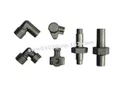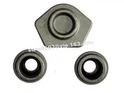

Hey there! As a forging parts supplier, I've seen firsthand the ins and outs of different forging processes. Today, I'm gonna break down the differences between hot forging and cold forging for parts. It's super important to understand these differences, whether you're in the manufacturing industry or just curious about how things are made.
Let's start with hot forging. In hot forging, the metal is heated to a high temperature, usually above its recrystallization temperature. This makes the metal more malleable and easier to shape. You can think of it like working with clay, but instead of cool, soft clay, it's super - hot metal!
One of the biggest advantages of hot forging is the ability to create complex shapes. The high temperature allows the metal to flow easily, so we can make parts with intricate details. This process is suitable for a wide range of metals, including carbon steels and stainless steels. For instance, we offer 1045 ,c45,Q235, St37 - 2, Q345 Carbon Steel Forging, which are often made using hot forging. The heat treatment during hot forging also helps to refine the grain structure of the metal, improving its mechanical properties. This results in parts that are stronger, more durable, and better able to withstand high stress and heavy loads.


However, hot forging isn't without its drawbacks. The high - temperature environment requires special equipment and safety measures. It also consumes a significant amount of energy, which can drive up production costs. And because the metal is so hot, there's a risk of oxidation and scaling on the surface of the part, which may require additional finishing steps.
Now, let's talk about cold forging. Cold forging is done at or near room temperature. Instead of heating the metal to make it soft, we rely on high pressure to deform the metal into the desired shape. This process is great for producing parts with high precision and excellent surface finish.
The precision in cold forging is one of its standout features. The parts come out very close to the final dimensions, which means less machining is needed later on. This not only saves time but also reduces material waste. For example, our OEM Stainless Steel 304 Precise Custom Forgings are often made using cold forging to achieve that high - precision finish.
Another advantage of cold forging is the increased strength of the parts. The cold - working process actually strengthens the metal by creating a more uniform and refined grain structure. This makes the parts more resistant to wear and fatigue, which is crucial for applications where reliability is key.
But cold forging also has its limitations. Not all metals are suitable for cold forging. Some metals are too brittle at room temperature and may crack or fracture during the forging process. Also, because we're working with cold metal, the equipment needs to be able to handle extremely high pressures. This means that the initial investment in cold - forging equipment can be quite high.
When it comes to production speed, hot forging and cold forging also differ. Hot forging is generally faster for large - scale production of simple - shaped parts. The heated metal is easier to deform, so we can produce parts more quickly. On the other hand, cold forging is often slower, especially for complex parts. The high - pressure process requires more time and precision to ensure the part is formed correctly.
In terms of cost, it's a bit of a mixed bag. Hot forging has higher energy costs, but it may require less expensive equipment. Cold forging has lower energy costs, but the equipment is more expensive. The cost also depends on the volume of production. For small - batch production, cold forging may be more cost - effective because it reduces the need for extensive machining. For large - batch production, hot forging may be the better choice due to its faster production speed.
Let's look at some real - world applications. Hot - forged parts are commonly used in the automotive and aerospace industries. Components like crankshafts, connecting rods, and turbine blades often require the high strength and complex shapes that hot forging can provide. Cold - forged parts are frequently used in the electronics and consumer goods industries. Items like bolts, nuts, and precision components need the high precision and excellent surface finish that cold forging offers.
As a forging parts supplier, we can offer both hot - forged and cold - forged parts to meet our customers' diverse needs. Whether you need a one - off custom part or a large - scale production run, we've got you covered. Our OEM Carbon Steel Stainless Steel Hot Forging service is perfect for those who need high - strength, complex - shaped parts. And if you're looking for precision and a great surface finish, our cold - forging options are the way to go.
So, if you're in the market for high - quality forging parts, don't hesitate to reach out. We're here to help you choose the right forging process for your specific application. Whether it's hot forging or cold forging, we'll work with you to ensure you get the best parts at the best price. Don't miss out on the opportunity to enhance your products with our top - notch forging solutions. Contact us today to start the procurement discussion and see how we can meet your forging needs!
References
- Smith, J. Forging Processes: A Comprehensive Guide. Metalworking Press, 2018.
- Johnson, M. The Differences between Hot and Cold Forging. Manufacturing Journal, 2020.
- Brown, R. Advances in Forging Technology. Industrial Engineering Review, 2021.