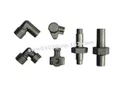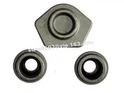

Forging is a crucial manufacturing process for producing high - strength parts, and forging lubricants play an indispensable role in this process. As a forging parts supplier, I have extensive experience in the forging industry and understand the importance of different forging lubricants and their functions. In this blog, I will delve into the various types of forging lubricants for parts and explain their specific functions.
Types of Forging Lubricants
Graphite - based Lubricants
Graphite is one of the most commonly used materials in forging lubricants. Graphite - based lubricants can be in the form of dry graphite powder, graphite suspensions in water or oil, or graphite emulsions.
Dry graphite powder is often used in hot forging processes. It has excellent high - temperature stability and can withstand the extreme heat generated during forging. When applied to the forging die, it forms a thin, lubricating film that reduces friction between the die and the workpiece. This film also helps to prevent the workpiece from sticking to the die, which is crucial for maintaining the quality of the forged parts. For example, in the production of OEM Carbon Steel Q235 St37 - 2 C45 1010 Forged Steel, dry graphite powder can be used to ensure smooth forging operations and high - precision parts.
Graphite suspensions and emulsions are more convenient to apply. They can be sprayed or brushed onto the die surface. The liquid carrier in these lubricants helps to evenly distribute the graphite particles, ensuring a uniform lubricating film. Water - based graphite suspensions are environmentally friendly and have good cooling properties, which can help to reduce the temperature of the die and the workpiece during forging. Oil - based graphite lubricants, on the other hand, provide better lubrication under high - pressure conditions and are suitable for heavy - duty forging operations.
Glass - based Lubricants
Glass - based lubricants are mainly used in high - temperature forging processes, especially for materials with high melting points such as superalloys. These lubricants have excellent thermal insulation properties, which can protect the forging die from the high - temperature workpiece. When heated, the glass lubricant forms a viscous, glassy layer on the die surface. This layer not only reduces friction but also acts as a barrier, preventing the diffusion of elements between the die and the workpiece.
In the forging of OEM Carbon Steel Stainless Steel Hot Forging, glass - based lubricants can be used to ensure the integrity of the forging process. They can help to maintain the surface quality of the forged parts and extend the service life of the forging die. However, glass - based lubricants are relatively expensive and require special handling and application techniques.
Polymer - based Lubricants
Polymer - based lubricants are a new type of forging lubricants that have gained popularity in recent years. These lubricants are made of polymers that can form a tough, elastic lubricating film on the die surface. Polymer - based lubricants have good adhesion and can withstand high - pressure and high - temperature conditions.
They are suitable for both hot and cold forging processes. In cold forging, polymer - based lubricants can reduce the forming force required, improve the surface finish of the parts, and prevent cracking. In hot forging, they can provide effective lubrication and protect the die from wear and corrosion. For instance, in the production of 1045, c45, Q235, St37 - 2, Q345 Carbon Steel Forging, polymer - based lubricants can enhance the forging efficiency and the quality of the final products.


Functions of Forging Lubricants
Reducing Friction
The primary function of forging lubricants is to reduce friction between the forging die and the workpiece. Friction during forging can cause several problems, such as increased forming force, uneven deformation of the workpiece, and premature wear of the die. By applying a lubricant, the coefficient of friction is significantly reduced, allowing the workpiece to flow more smoothly in the die cavity. This results in more accurate and consistent part dimensions, as well as improved surface quality.
For example, in the forging of complex - shaped parts, a good lubricant can ensure that the metal flows evenly into all corners of the die, reducing the risk of defects such as folds and cracks. It also helps to lower the energy consumption during forging, as less force is required to deform the workpiece.
Preventing Sticking
Sticking between the workpiece and the forging die is a common problem in forging processes. It can lead to surface damage of the forged parts, as well as increased wear and tear of the die. Forging lubricants form a protective layer between the two surfaces, preventing direct contact and adhesion.
This is particularly important when forging materials that have a high tendency to stick, such as stainless steel and some alloys. A suitable lubricant can ensure that the forged part can be easily ejected from the die, reducing the production time and improving the overall efficiency of the forging process.
Cooling the Die and the Workpiece
During forging, a large amount of heat is generated due to the deformation of the metal and the friction between the die and the workpiece. Excessive heat can cause thermal fatigue of the die, reducing its service life. Forging lubricants, especially water - based ones, can help to dissipate heat from the die and the workpiece.
The cooling effect of the lubricant can also improve the mechanical properties of the forged parts. By controlling the cooling rate, the microstructure of the metal can be optimized, resulting in better strength and toughness.
Protecting the Die from Wear and Corrosion
The forging die is a critical and expensive tool in the forging process. Forging lubricants can protect the die from wear and corrosion. The lubricating film formed on the die surface acts as a barrier, preventing the abrasive particles in the workpiece from scratching the die.
In addition, some forging lubricants contain anti - corrosion additives that can protect the die from oxidation and chemical attack. This helps to extend the service life of the die, reducing the cost of tooling and improving the overall profitability of the forging operation.
Choosing the Right Forging Lubricant
Selecting the appropriate forging lubricant depends on several factors, including the type of forging process (hot or cold), the material of the workpiece, the shape and complexity of the part, and the forging equipment.
For hot forging of carbon steel and alloy steel, graphite - based lubricants are often a good choice due to their high - temperature stability and cost - effectiveness. For high - temperature forging of superalloys and other high - melting - point materials, glass - based lubricants may be more suitable. In cold forging, polymer - based lubricants can provide excellent lubrication and surface protection.
It is also important to consider the environmental impact of the lubricant. Water - based lubricants are generally more environmentally friendly than oil - based ones, as they produce less pollution and are easier to clean up.
Conclusion
Forging lubricants are essential for the successful production of high - quality forging parts. As a forging parts supplier, I understand the importance of using the right lubricant to ensure the efficiency and quality of the forging process. By choosing the appropriate forging lubricant, we can reduce friction, prevent sticking, cool the die and the workpiece, and protect the die from wear and corrosion.
If you are in the market for high - quality forging parts and need more information about the forging process and the use of lubricants, please feel free to contact us for procurement and negotiation. We are committed to providing you with the best products and services to meet your specific needs.
References
- "Forging Handbook: Processes, Materials, and Design" by George E. Totten and D. Scott MacKenzie
- "Metal Forming: Mechanics and Metallurgy" by Dieter K. Matthes
- Technical papers from leading forging lubricant manufacturers