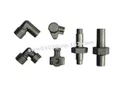

Alloy steels have long been a cornerstone in the manufacturing of high - performance forging parts. As a forging parts supplier, I have witnessed firsthand the unique forging characteristics of parts made from these materials. In this blog, I will delve into the key forging characteristics of alloy steel parts, exploring their advantages and how they impact the overall quality and performance of the forged products.
1. High Strength and Toughness
One of the most prominent features of alloy steel forging parts is their high strength and toughness. Alloy steels are composed of iron as the base metal, with the addition of various alloying elements such as chromium, nickel, molybdenum, and vanadium. These elements work together to enhance the mechanical properties of the steel.
During the forging process, the high - strength nature of alloy steels allows them to withstand significant deformation without cracking. For example, in the automotive industry, alloy steel forged parts like crankshafts and connecting rods need to endure high - stress conditions during engine operation. The toughness of alloy steels ensures that these parts can absorb energy and resist sudden impacts, reducing the risk of failure.
The strength and toughness of alloy steel forging parts are also influenced by the forging temperature and the rate of deformation. When forging alloy steels, it is crucial to maintain an optimal temperature range. If the temperature is too low, the steel may be too hard and brittle, leading to cracking during forging. On the other hand, if the temperature is too high, the grain structure of the steel may become coarse, reducing its strength and toughness.
2. Good Hardenability
Hardenability is a measure of how deep a steel can be hardened when quenched. Alloy steels generally have good hardenability compared to carbon steels. This is because the alloying elements in alloy steels slow down the cooling rate required for the formation of martensite, a hard and brittle phase of steel.
In the forging process, good hardenability allows for more flexibility in heat treatment. After forging, the parts can be heat - treated to achieve the desired hardness and strength. For instance, in the manufacturing of gears, alloy steel forging parts can be quenched and tempered to obtain a hard surface layer for wear resistance and a tough core for shock absorption.
The hardenability of alloy steels also affects the selection of quenching media. Different alloy steels may require different quenching media, such as oil or water, depending on their hardenability. A forging parts supplier needs to have a good understanding of the hardenability of the alloy steels they are using to ensure proper heat treatment and achieve the best mechanical properties for the final products.
3. Resistance to Wear and Corrosion
Alloy steel forging parts often exhibit excellent resistance to wear and corrosion. The addition of alloying elements such as chromium and nickel can form a protective oxide layer on the surface of the steel, preventing it from corroding. This is particularly important in applications where the parts are exposed to harsh environments, such as in the marine and chemical industries.
In terms of wear resistance, alloy steels can be designed to have a high hardness and a fine - grained structure, which reduces the friction and wear between the parts. For example, in mining equipment, alloy steel forging parts like drill bits and conveyor rollers need to withstand severe wear during operation. The wear - resistant properties of alloy steels ensure a longer service life for these parts, reducing maintenance costs and downtime.
The forging process can also enhance the wear and corrosion resistance of alloy steel parts. By properly controlling the forging parameters, such as the forging ratio and the finishing temperature, the surface quality and density of the parts can be improved, further enhancing their resistance to wear and corrosion.
4. Machinability
While alloy steels are known for their high strength and toughness, their machinability can vary depending on the type and amount of alloying elements. Some alloy steels may be more difficult to machine than carbon steels due to their higher hardness and the presence of hard alloying compounds.
However, with the development of modern machining technologies and the use of appropriate cutting tools, the machinability of alloy steel forging parts can be improved. For example, using high - speed steel or carbide cutting tools can increase the cutting speed and feed rate, reducing the machining time and improving the surface finish of the parts.
As a forging parts supplier, it is important to consider the machinability of the alloy steels when designing and manufacturing the parts. By selecting the right alloy steel and optimizing the forging and machining processes, we can ensure that the final products meet the customer's requirements in terms of both mechanical properties and dimensional accuracy.
5. Dimensional Stability
Alloy steel forging parts typically have good dimensional stability. During the forging process, the steel is subjected to high pressure and deformation, which helps to eliminate internal voids and improve the density of the material. This results in parts with more consistent dimensions and fewer dimensional variations.
In applications where precise dimensions are critical, such as in the aerospace and precision machinery industries, the dimensional stability of alloy steel forging parts is highly valued. For example, in the manufacturing of aircraft engine components, the tight tolerances and high dimensional accuracy of the parts are essential for the proper functioning of the engine.
The heat treatment process after forging also plays a role in maintaining the dimensional stability of alloy steel parts. By carefully controlling the heating and cooling rates during heat treatment, the internal stresses in the parts can be minimized, reducing the risk of distortion and ensuring that the parts retain their intended dimensions.
Conclusion
In conclusion, the forging characteristics of parts made of alloy steels, including high strength and toughness, good hardenability, resistance to wear and corrosion, machinability, and dimensional stability, make them an ideal choice for a wide range of applications. As a forging parts supplier, we are committed to leveraging these characteristics to produce high - quality forging parts that meet the diverse needs of our customers.
If you are interested in our OEM Carbon Steel Stainless Steel Hot Forging services, please visit OEM Carbon Steel Stainless Steel Hot Forging. We are also a China Professional Forging Parts Manufacturers In Ningbo, offering high - quality forging parts with professional expertise. For those looking for China Big Quantity With Low Price Cold Forging, we can provide cost - effective solutions.
If you have any requirements for forging parts, feel free to contact us for procurement and negotiation. We look forward to working with you to create excellent forging products.


References
- ASM Handbook Committee. ASM Handbook Volume 14A: Metalworking: Forging. ASM International, 2013.
- Dieter, G. E. Mechanical Metallurgy. McGraw - Hill, 1986.
- Kalpakjian, S., & Schmid, S. R. Manufacturing Engineering and Technology. Pearson, 2014.