
Hey there! I'm a supplier of forging parts, and I've been in the business for quite a while. Today, I want to talk about the forging operations for parts with high - strength and low - weight requirements. These types of parts are in high demand in many industries, like aerospace, automotive, and sports equipment.
Why High - Strength and Low - Weight Parts?
Before we dive into the forging operations, let's quickly understand why these parts are so important. In industries such as aerospace, every extra pound can cost a fortune in fuel. So, having parts that are both strong and light can significantly reduce operational costs and improve performance. In the automotive industry, lightweight and strong parts can enhance fuel efficiency and vehicle handling. And in sports equipment, they can provide better performance and comfort for athletes.
Forging Materials
Aluminum Alloys
Aluminum alloys are a popular choice for high - strength and low - weight parts. They have a high strength - to - weight ratio, which means they can withstand a lot of stress while being relatively light. For example, the 6061 - T6 aluminum alloy is well - known for its good combination of strength, corrosion resistance, and machinability. As a Professional 6061 - T6 Aluminum Forging Suppliers, we've had great success in producing parts using this alloy. It's commonly used in the aerospace and automotive industries for components like brackets, frames, and engine parts.
Titanium Alloys
Titanium alloys are another excellent option. They offer even higher strength - to - weight ratios than aluminum alloys, along with excellent corrosion resistance. However, they are more expensive and harder to work with. Titanium is often used in high - end aerospace applications, such as aircraft engine components and structural parts, where the performance benefits justify the higher cost.
Carbon Steel
Carbon steel can also be used for high - strength parts. While it's not as light as aluminum or titanium, certain types of carbon steel, like the OEM Carbon Steel Q235 St37 - 2 C45 1010 Forged Steel OEM Carbon Steel Q235 St37 - 2 C45 1010 Forged Steel, can be heat - treated to achieve high strength. It's a cost - effective option for applications where weight is not the primary concern, such as in some automotive and machinery parts.
Forging Operations
Open - Die Forging
Open - die forging is a versatile process that can be used to produce a wide range of shapes and sizes. In this process, the metal is placed between two flat or shaped dies, and a hammer or press applies force to deform the metal. It's great for creating large, simple - shaped parts. For high - strength and low - weight parts, open - die forging can be used to pre - shape the material before further processing. It helps to align the grain structure of the metal, which can improve its strength.

Closed - Die Forging
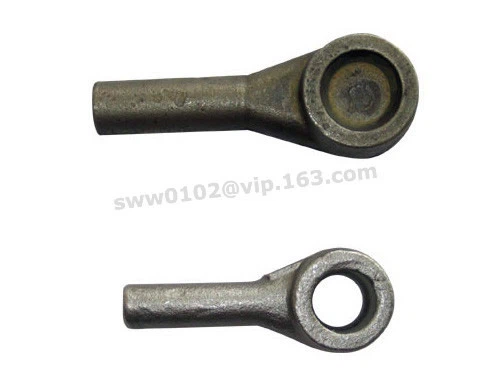
Closed - die forging, also known as impression - die forging, is more precise than open - die forging. In this process, the metal is placed in a die cavity, and a hammer or press forces the metal to fill the cavity. This results in parts with a more complex shape and better dimensional accuracy. Closed - die forging is often used for mass - producing high - strength and low - weight parts. It can produce parts with a fine grain structure, which enhances their mechanical properties.
Isothermal Forging
Isothermal forging is a specialized process that is used for materials that are difficult to form, such as titanium alloys. In this process, the dies and the workpiece are heated to the same temperature. This reduces the deformation resistance of the metal and allows for more uniform deformation. Isothermal forging can produce parts with excellent mechanical properties and a high degree of dimensional accuracy.
Heat Treatment
After forging, heat treatment is often necessary to achieve the desired strength and hardness. Heat treatment involves heating the part to a specific temperature and then cooling it at a controlled rate. For example, quenching and tempering are common heat - treatment processes for carbon steel. Quenching involves rapidly cooling the part in a liquid, which hardens the steel. Tempering is then done to reduce the brittleness and improve the toughness of the steel.
For aluminum alloys, solution heat treatment and aging are commonly used. Solution heat treatment involves heating the alloy to a high temperature to dissolve the alloying elements, and then rapidly cooling it. Aging is then done at a lower temperature to precipitate the alloying elements, which increases the strength of the alloy.
Machining and Finishing
Once the forging and heat treatment are complete, the parts may need to be machined to achieve the final dimensions and surface finish. Machining operations such as milling, turning, and drilling are used to remove excess material and create the required features. After machining, finishing operations like grinding, polishing, or coating may be done to improve the appearance and corrosion resistance of the parts.
Quality Control
Quality control is crucial throughout the forging process. We use a variety of inspection methods, such as non - destructive testing (NDT), to ensure the parts meet the required standards. NDT methods include ultrasonic testing, magnetic particle testing, and X - ray testing. These methods can detect internal defects, such as cracks or voids, without damaging the parts. We also perform mechanical testing, such as tensile testing and hardness testing, to verify the mechanical properties of the parts.
Conclusion
In conclusion, producing parts with high - strength and low - weight requirements involves a combination of the right materials, forging operations, heat treatment, machining, and quality control. As a Custom 7year Experience Aluminum And Stainless Steel Forging Company, we have the expertise and experience to meet the diverse needs of our customers. Whether you're in the aerospace, automotive, or sports equipment industry, we can provide you with high - quality forging parts that meet your specific requirements.
If you're interested in purchasing our forging parts or have any questions about the forging process, feel free to contact us for a procurement negotiation. We're always happy to discuss your needs and find the best solutions for you.
References
- "Metal Forming and Forging Handbook"
- "ASM Handbook: Volume 14A - Metalworking: Forging"
- "Aluminum Alloys: Structure and Properties"