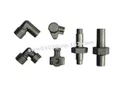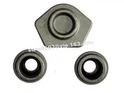

Hey there! As a forging parts supplier, I've got a ton of experience with tubular parts forging. In this blog, I'm gonna walk you through the different forging operations for tubular parts. So, let's dive right in!
1. Upsetting
Upsetting is one of the fundamental forging operations for tubular parts. It involves increasing the cross - sectional area of a tube by reducing its length. This is usually done by applying compressive forces at the ends of the tube.
Think of it like squeezing a play - dough tube. When you push the ends together, the middle part gets fatter. In the forging process, we use hydraulic or mechanical presses to achieve this. The advantage of upsetting is that it can create thicker walls at specific sections of the tube, which can enhance the strength of the part.
For example, if we're making a tubular part that needs to withstand high pressure at one end, upsetting that end can increase its wall thickness and make it more resistant. Our company offers OEM Aisi1045 Steel Precise Press Forging, where upsetting is often used to customize the wall thickness of the tubular steel parts according to the customer's requirements.
2. Extrusion
Extrusion is another important operation. In extrusion, we force the tubular material through a die to create a desired cross - sectional shape. It's similar to squeezing toothpaste out of a tube, but in a more controlled and precise way.
There are two main types of extrusion for tubular parts: direct and indirect. In direct extrusion, the material is pushed through the die, while in indirect extrusion, the die moves towards the material.
Extrusion allows us to create complex cross - sectional shapes, like tubes with non - circular profiles. This is great for applications where the part needs to fit into a specific space or perform a unique function. For instance, in the automotive industry, tubular parts with special cross - sections are often used for fluid transfer systems. We're proud to be Professional 6061 - T6 Aluminum Forging Suppliers, and we use extrusion to make high - quality 6061 - T6 aluminum tubular parts with precise cross - sections.
3. Piercing
Piercing is used to create holes in tubular parts. It can be done before or after other forging operations. There are different methods of piercing, such as punch piercing and drill piercing.
Punch piercing is a fast and efficient way to create holes. A punch is forced through the tube wall to create the hole. Drill piercing, on the other hand, is more precise and is often used when high accuracy is required.
Piercing is crucial for many applications. For example, in the construction of tubular frames, holes are needed for bolts and other fasteners. Our OEM 6061 - T6 Forged Aluminum With CNC Machining service includes precise piercing operations to ensure that the holes in the tubular aluminum parts meet the exact specifications of our customers.
4. Rolling
Rolling is a process where we pass the tubular part through a set of rolls to change its shape or size. There are different types of rolling operations for tubular parts, such as ring rolling and tube rolling.
Ring rolling is used to make rings or tubular parts with a circular cross - section. The tube is placed between two rolls, and as the rolls rotate, the tube's diameter increases while its wall thickness decreases. Tube rolling, on the other hand, can be used to reduce the diameter of a tube or improve its surface finish.
Rolling can improve the mechanical properties of the tubular part by aligning the grain structure. This makes the part stronger and more durable. We often use rolling in our forging processes to ensure that the tubular parts we produce have excellent mechanical performance.
5. Bending
Bending is an operation that changes the shape of the tubular part by curving it. It's commonly used in applications where the part needs to follow a specific path or fit into a curved space.


There are several methods of bending tubular parts, such as press bending, rotary draw bending, and roll bending. Press bending is suitable for simple bends, while rotary draw bending is more precise and can be used for complex bends. Roll bending is often used for large - diameter tubes.
Bending is widely used in industries like furniture manufacturing, where tubular parts are bent to create the frames of chairs and tables. We have the expertise to perform various bending operations on tubular parts to meet the diverse needs of our customers.
6. Swaging
Swaging is a process that reduces the diameter of a tube at one or both ends. It can be done by either hammering or using a swaging machine.
Swaging is useful when we need to connect two tubes of different diameters or when we want to create a tapered end on a tube. For example, in plumbing applications, swaged tubes can be easily connected to other components. Our forging team is well - versed in swaging techniques to ensure that the tubular parts we produce have the right end shapes for seamless integration into the final products.
Factors Affecting Forging Operations
There are several factors that can affect the forging operations of tubular parts. The material of the tube is a major factor. Different materials have different properties, such as ductility, strength, and hardness. For example, aluminum is more ductile than steel, which means it can be more easily formed through operations like extrusion and upsetting.
The temperature at which the forging is done also matters. Most forging operations are carried out at elevated temperatures to make the material more malleable. However, the optimal temperature varies depending on the material. For steel, the forging temperature is usually between 800°C and 1200°C, while for aluminum, it's around 350°C to 500°C.
The design of the die and the tooling used in the forging process also play a crucial role. A well - designed die can ensure that the tubular part is formed accurately and efficiently.
Quality Control in Forging Tubular Parts
Quality control is essential in the forging of tubular parts. We use a variety of inspection methods to ensure that the parts meet the required standards.
Non - destructive testing methods, such as ultrasonic testing and magnetic particle testing, are used to detect internal defects in the tubular parts. Dimensional inspection is also carried out using tools like calipers and micrometers to ensure that the part's size and shape are within the specified tolerances.
We also perform mechanical testing, such as tensile testing and hardness testing, to evaluate the mechanical properties of the tubular parts. This helps us to ensure that the parts can perform their intended functions in the final application.
Why Choose Us as Your Forging Parts Supplier
As a forging parts supplier, we have a team of experienced engineers and technicians who are experts in all the forging operations for tubular parts. We use state - of - the - art equipment and the latest manufacturing techniques to ensure the high quality of our products.
We offer a wide range of forging services, from simple to complex operations, and we can customize the tubular parts according to your specific requirements. Whether you need OEM 6061 - T6 Forged Aluminum With CNC Machining or OEM Aisi1045 Steel Precise Press Forging, we've got you covered.
If you're in the market for high - quality forging parts, we'd love to hear from you. Whether you have a small - scale project or a large - scale production order, we're ready to work with you. Contact us to start a discussion about your forging needs and let's create the perfect tubular parts together!
References
- "Metal Forming: Processes and Analysis" by David A. Dieter
- "Forging Handbook: Die Design, Tooling, and Presses" by American Society for Metals