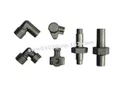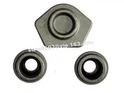

Hey there! I'm a supplier of forging parts, and today I wanna chat about the forging part manufacturing processes for parts with high - strength and high - toughness requirements.
First off, let's understand why high - strength and high - toughness parts are so important. In industries like aerospace, automotive, and heavy machinery, these parts are the backbone. They need to withstand extreme forces, impacts, and stress without failing. A tiny crack or break in a high - stress component can lead to catastrophic consequences, so getting the manufacturing process right is crucial.
1. Material Selection
The very first step in making high - strength and high - toughness forging parts is choosing the right material. We can't just pick any old metal. For instance, alloy steels are often a top choice. They're made by adding elements like chromium, nickel, and molybdenum to carbon steel. These alloying elements improve the steel's strength, toughness, and resistance to wear and corrosion.
Another option is titanium alloys. They're super lightweight but still incredibly strong and tough. Titanium is widely used in aerospace applications because of its excellent strength - to - weight ratio. Aluminum alloys are also used in some cases, especially when weight reduction is a key factor, like in the automotive industry.
2. Heating the Material
Once we've selected the right material, the next step is to heat it up. Heating is essential because it makes the metal more malleable, allowing us to shape it into the desired form. We heat the metal to a specific temperature range, which depends on the type of material.
For most steels, we heat them to around 1,100 - 1,200 degrees Celsius. This temperature range is called the forging temperature. Heating the metal too much can cause it to lose its strength and toughness, while not heating it enough can make it difficult to shape.
We use different types of furnaces to heat the metal, such as electric furnaces and gas - fired furnaces. Electric furnaces are more precise in controlling the temperature, while gas - fired furnaces are often used for large - scale production because they can heat the metal quickly.
3. Forging Process
Now, let's talk about the actual forging process. There are two main types of forging: open - die forging and closed - die forging.
Open - Die Forging
In open - die forging, the metal is placed between two flat or shaped dies, and the dies are then pressed together to deform the metal. This process is great for making large and simple - shaped parts. It allows for a lot of flexibility in terms of the size and shape of the part.
For example, Large Dimension Q235 Carbon Steel Open Die Forging is a product that's made using open - die forging. The Q235 carbon steel is heated and then shaped between the open dies to create a large - dimension part.
Open - die forging is also useful for pre - shaping the metal before further processing. It can improve the metal's internal structure, making it more homogeneous and enhancing its strength and toughness.
Closed - Die Forging
Closed - die forging, on the other hand, uses a set of dies that completely enclose the metal. The dies have a cavity in the shape of the final part. When the dies are pressed together, the metal is forced to fill the cavity, taking on the exact shape of the part.
This process is more precise and can produce parts with complex shapes and tight tolerances. It's commonly used for making parts like gears, connecting rods, and crankshafts. OEM Aisi1045 Steel Precise Press Forging is an example of a product made using closed - die forging. The Aisi1045 steel is heated and then forged in a closed - die setup to create a precise part.
4. Heat Treatment
After forging, the part needs to go through heat treatment. Heat treatment is a crucial step to improve the part's strength and toughness. There are different types of heat treatment processes, such as quenching, tempering, and annealing.
Quenching
Quenching involves rapidly cooling the forged part in a liquid medium, such as water, oil, or polymer solution. This rapid cooling causes the metal's structure to change, forming a hard and strong phase called martensite. However, quenching can also make the part brittle, so it's usually followed by tempering.
Tempering
Tempering is the process of reheating the quenched part to a lower temperature and then cooling it slowly. This helps to relieve the internal stresses created during quenching and makes the part more ductile and tough. By adjusting the tempering temperature and time, we can control the part's final strength and toughness.
Annealing
Annealing is a heat treatment process that involves heating the part to a high temperature and then cooling it slowly. This process is used to soften the metal, improve its machinability, and relieve internal stresses. It's often used as a pre - treatment before forging or as a post - treatment to improve the part's overall properties.
5. Machining and Finishing
Once the heat treatment is done, the part may need some machining to achieve the final dimensions and surface finish. Machining processes include turning, milling, drilling, and grinding. These processes remove any excess material and create the precise features and tolerances required for the part.
After machining, the part may go through some finishing processes, such as surface coating or plating. Surface coating can improve the part's corrosion resistance, wear resistance, and appearance. For example, we can apply a zinc coating or a paint coating to protect the part from rust.
6. Quality Control
Throughout the entire manufacturing process, quality control is essential. We use various inspection methods to ensure that the parts meet the high - strength and high - toughness requirements. Non - destructive testing methods, such as ultrasonic testing, magnetic particle testing, and X - ray testing, are used to detect any internal defects in the part.
We also perform mechanical testing, such as tensile testing, hardness testing, and impact testing, to verify the part's strength and toughness. Only parts that pass all the quality control tests are considered acceptable for use.


Why Choose Us?
As a forging parts supplier, we have years of experience in manufacturing high - strength and high - toughness forging parts. We use the latest technology and equipment to ensure the highest quality of our products. Our team of experts is always on hand to provide technical support and advice.
We're also committed to providing excellent customer service. We understand that every customer has unique requirements, and we're willing to work closely with you to meet those needs. Whether you need a small batch of custom - made parts or a large - scale production run, we can handle it.
If you're in the market for high - strength and high - toughness forging parts, don't hesitate to get in touch with us. We'd love to have a chat with you about your requirements and see how we can help. You can check out our China Professional Forging Parts Manufacturers In Ningbo page to learn more about our products and services.
So, if you're looking for a reliable forging parts supplier, give us a shout. We're ready to start a great partnership with you and provide you with the best forging parts on the market.
References
- ASM Handbook Volume 14A: Metalworking: Forging. ASM International.
- Callister, W. D., & Rethwisch, D. G. (2017). Materials Science and Engineering: An Introduction. Wiley.
- Dieter, G. E. (1988). Mechanical Metallurgy. McGraw - Hill.