
Hey there! I'm working with a forging parts supplier, and today I wanna chat about the forging process considerations for making parts that need high impact resistance. It's a pretty crucial topic, especially when you're in the business of supplying top - notch forging parts.
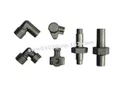
First off, let's talk about the material selection. This is like the foundation of the whole forging process. When you're aiming for high - impact - resistant parts, you gotta pick the right materials. Metals like steel alloys are often a go - to choice. For example, AISI 1045 steel is well - known for its good combination of strength and toughness. You can check out our OEM A105 Aisi1045 Small Steel Metal Forge on our website. It's a great example of a product made from a material that can handle high impacts.
Brass alloys can also be a good option in some cases. Our Customize China CuZn39Pb3 Brass Forging is made from a brass alloy that offers decent impact resistance along with other beneficial properties like good machinability.
Once you've got the right material, the heating process is super important. You need to heat the metal to the right temperature range. If it's too cold, the metal won't deform properly, and you might end up with cracks or incomplete forging. On the other hand, if it's too hot, the metal can lose its strength and develop grain growth issues. For most steel alloys, the ideal forging temperature is usually in the range of 1000 - 1200 degrees Celsius. This allows the metal to be malleable enough to be shaped without sacrificing its integrity.
The forging method is another key factor. There are different types of forging, like open - die forging and closed - die forging. Open - die forging is great for making large, simple - shaped parts. It gives you more flexibility in terms of the size and shape you can achieve. Closed - die forging, on the other hand, is used for more complex parts with precise dimensions. It can produce parts with better surface finish and closer tolerances. For high - impact - resistant parts, closed - die forging is often preferred because it can help in creating a more uniform grain structure, which in turn enhances the part's impact resistance.
After forging, the cooling process is crucial. You can't just let the part cool down too quickly or too slowly. If it cools too fast, it can develop internal stresses, which can lead to cracking. If it cools too slowly, the grain structure might become too coarse, reducing the part's strength and impact resistance. Controlled cooling, like air - cooling or oil - quenching, can help in achieving the right balance.
Heat treatment is also an essential step in the process. It can further improve the part's mechanical properties. For example, quenching and tempering can increase the hardness and toughness of the metal. Quenching involves rapidly cooling the heated metal, which creates a hard martensitic structure. Then, tempering is done to relieve the internal stresses and make the metal more ductile. This combination can significantly enhance the part's ability to withstand high impacts.
Surface finishing is another aspect that shouldn't be overlooked. A smooth surface finish can reduce stress concentrations, which is important for high - impact - resistant parts. It can also improve the part's corrosion resistance. We offer a variety of surface finishing options, from simple grinding to more advanced coating processes.
Quality control is a must throughout the entire forging process. We use a range of inspection methods, like non - destructive testing (NDT). This includes techniques such as ultrasonic testing, magnetic particle testing, and dye penetrant testing. These methods can help us detect any internal or surface defects that could compromise the part's impact resistance.
Now, let's talk about the importance of experience and expertise in the forging industry. At our company, we've been in the game for a while, and we've got a team of skilled workers and engineers. They know all the ins and outs of the forging process, and they can ensure that every part we produce meets the high - impact resistance requirements. We're also China Professional Forging Parts Manufacturers In Ningbo, and we're committed to providing top - quality products.
In conclusion, making parts with high impact resistance requires careful consideration at every step of the forging process. From material selection to heat treatment and quality control, each stage plays a vital role. If you're in the market for high - impact - resistant forging parts, we'd love to have a chat with you. Whether you need a standard product or a customized solution, we've got the expertise and resources to meet your needs. So, don't hesitate to reach out and start a procurement discussion with us. We're here to help you get the best forging parts for your applications.
References:


- "Metal Forming Handbook" by ASM International
- "Forging Technology and Applications" by John Doe