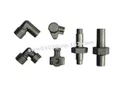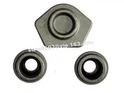

Hey there! As a forging parts supplier, I've been in the game for quite a while, and I've seen firsthand how crucial the mechanical properties of forging parts are. These properties can make or break a part's performance in various applications. So, let's dive into the key factors that affect the mechanical properties of forging parts.
Material Selection
The first and most fundamental factor is the material we choose for forging. Different materials have different inherent properties, and these properties directly influence the mechanical performance of the final forging part. For example, steel is one of the most commonly used materials in forging. It comes in various grades, each with its own unique combination of strength, hardness, and ductility.
High - carbon steel, for instance, is known for its high strength and hardness. It's great for applications where wear resistance and high - load bearing capacity are required, like in automotive engine components. On the other hand, low - carbon steel is more ductile and easier to form. It's often used in parts that need to be bent or shaped without cracking, such as brackets and frames.
Alloy steels are another option. By adding elements like chromium, nickel, and molybdenum, we can enhance specific properties. Chromium improves corrosion resistance, while nickel increases toughness. These alloyed materials are used in high - performance applications, such as aerospace components. If you're interested in high - quality stainless steel forgings, check out our OEM Stainless Steel 304 Precise Custom Forgings.
Forging Temperature
The temperature at which forging takes place is a game - changer. There are three main types of forging based on temperature: cold forging, warm forging, and hot forging.
Cold forging is done at room temperature. It offers high precision and good surface finish. Since the material is not heated, there's no oxidation, which means the part retains its dimensional accuracy. However, the material's resistance to deformation is high, so cold forging is usually limited to relatively small parts and materials with good ductility.
Warm forging is carried out at temperatures between room temperature and the recrystallization temperature of the material. This method combines some of the advantages of cold and hot forging. It reduces the force required for deformation compared to cold forging and also improves the material's formability.
Hot forging is the most common method. The material is heated above its recrystallization temperature, which makes it extremely malleable. The grains in the material recrystallize during hot forging, resulting in a fine - grained structure that enhances the mechanical properties of the part. However, hot forging requires careful temperature control. If the temperature is too high, the material can become over - heated, leading to grain growth and a decrease in strength. Our Professional Metal Forging Process ensures precise temperature control for optimal results.
Deformation Ratio
The deformation ratio, also known as the reduction ratio, is the ratio of the initial cross - sectional area of the material to the final cross - sectional area after forging. A higher deformation ratio generally leads to better mechanical properties.
When we apply a large amount of deformation to the material during forging, the grains in the material are elongated and refined. This refined grain structure increases the strength and toughness of the part. However, there's a limit to how much deformation we can apply. If the deformation ratio is too high, the material may crack or develop internal defects.
We need to find the right balance based on the material and the desired properties of the forging part. For example, in some cases, multiple forging steps with intermediate heat treatments may be required to achieve the optimal deformation ratio without causing damage to the material.
Heat Treatment
Heat treatment is a post - forging process that can significantly alter the mechanical properties of forging parts. There are several types of heat treatments, including annealing, normalizing, quenching, and tempering.
Annealing is a process in which the forging part is heated to a specific temperature and then slowly cooled. This process relieves internal stresses, softens the material, and improves its ductility. It's often used as a pre - machining treatment to make the material easier to cut.
Normalizing is similar to annealing, but the cooling rate is faster. Normalizing refines the grain structure and improves the mechanical properties of the material, making it more suitable for general engineering applications.
Quenching is a rapid cooling process. When a forging part is quenched, it undergoes a phase transformation that increases its hardness. However, quenching also introduces high internal stresses, which can cause the part to crack. That's why quenching is usually followed by tempering.
Tempering is the process of reheating the quenched part to a lower temperature and then cooling it. Tempering reduces the internal stresses and brittleness introduced by quenching while maintaining a high level of hardness. Heat treatment is a critical step in our OEM Professiona Supply Casting And Forging In Ningbo China to ensure the best performance of our forging parts.
Die Design
The design of the forging die plays a crucial role in determining the mechanical properties of the forging part. A well - designed die can ensure uniform deformation of the material during forging.


The shape of the die cavity affects how the material flows. If the die cavity is not properly designed, the material may not fill the cavity completely, leading to incomplete parts or areas with inconsistent mechanical properties. The die also needs to be able to withstand the high pressures and temperatures during forging.
We use advanced computer - aided design (CAD) and simulation techniques to optimize the die design. This helps us predict how the material will flow during forging and make adjustments to the die shape as needed. By ensuring uniform deformation, we can produce forging parts with consistent and high - quality mechanical properties.
Quality Control
Last but not least, quality control is essential throughout the forging process. We use a variety of inspection methods to ensure that the forging parts meet the required standards.
Non - destructive testing methods, such as ultrasonic testing, magnetic particle testing, and X - ray testing, are used to detect internal defects in the forging parts. These methods allow us to identify cracks, porosity, and other flaws without damaging the part.
Destructive testing methods, such as tensile testing, hardness testing, and impact testing, are used to evaluate the mechanical properties of the forging parts. By taking samples from the forging parts and subjecting them to these tests, we can determine the strength, hardness, and toughness of the material.
We have a strict quality control system in place to ensure that every forging part we produce meets the highest standards of quality and performance.
In conclusion, the mechanical properties of forging parts are affected by a variety of factors, including material selection, forging temperature, deformation ratio, heat treatment, die design, and quality control. As a forging parts supplier, we pay close attention to each of these factors to produce high - quality forging parts that meet the specific needs of our customers.
If you're in the market for top - notch forging parts, we'd love to talk to you. Whether you have a specific design in mind or need help with material selection and process optimization, our team of experts is here to assist you. Let's start a conversation and see how we can work together to meet your forging part requirements.
References
- ASM Handbook Committee, "ASM Handbook Volume 14A: Metalworking: Forging", ASM International, 2013.
- Dieter, G. E., "Mechanical Metallurgy", McGraw - Hill, 1986.
- Kalpakjian, S., & Schmid, S. R., "Manufacturing Engineering and Technology", Pearson, 2014.